


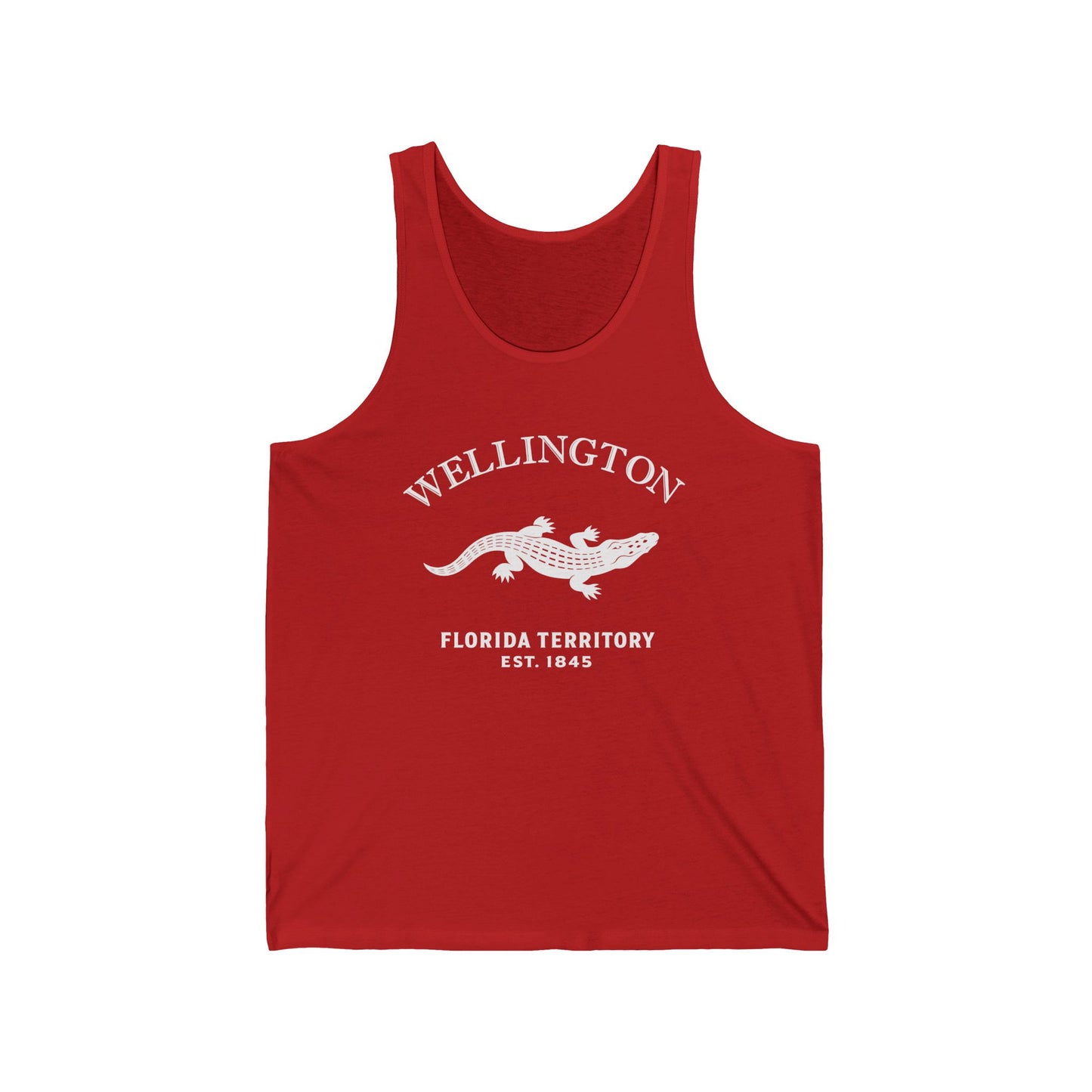
Our Wellington retro logo uses a Florida alligator motif, representing toughness, adaptability, and connection to Florida's wild heritage. The alligator reflects both literal wildlife in the reclaimed swamps and symbolic resilience against storms. The "EST. 1845" date marks Florida statehood — Florida was admitted to the Union as the twenty-seventh state on March 3, 1845. Its black-and-white styling resembles crate labels or woodcut stamps, authentic and retro rather than glossy. The motif bridges Wellington's dual identity: reclaimed marshland turned village, and equestrian capital rooted in resilience. On merchandise, it feels vintage and rugged, honoring Wellington's layered story while celebrating its Florida heritage of toughness and adaptability.
Wellington began as a Harvard accountant's joke about his own initials. In the 1950s a Massachusetts investor and aviator named Charles Oliver Wellington assembled some eighteen thousand acres of waterlogged Everglades-edge swampland in central Palm Beach County and named it the Flying Cow Ranch — "Cow" for his initials, C.O.W., and "Flying" because he flew his own planes, with a landing strip running along what is still called Flying Cow Road today. The land flooded constantly — its southwestern boundary is the Everglades itself — so in 1953 the Acme Drainage District was created to engineer the swamp into farmland, and the reclaimed acres grew citrus and, at their height, some two thousand acres of strawberries, claimed for a time as the world's largest strawberry patch. After Wellington's death in 1959 the ranch passed to his family and then to developers; Palm Beach County approved a planned community in 1972, and in 1977 polo arrived, and everything changed. Wealthy owners from nearby Palm Beach looked west for room to keep horses, build rings, and lay out polo fields, and the old strawberry country became horse country. The Village of Wellington incorporated on December 31, 1995, and in 2002 set aside thousands of acres as an Equestrian Preserve, threaded by dozens of miles of public bridle trails. Today, at the height of the winter season, tens of thousands of horses are stabled here, drawn by show jumping, dressage, and polo, and Wellington calls itself the Winter Equestrian Capital of the World. It is a town that lives on engineered land, where the high water table is never far below the footing and the old wetland logic still runs underneath the manicured rings — flat, subtropical, hurricane-country South Florida, where horses move with bright precision on land that remembers being water. From a Harvard aviator's Flying Cow Ranch and the world's largest strawberry patch to the horse country of South Florida, that is the unlikely arc of Wellington.
Why People Visit Wellington Florida
- Take in the winter equestrian season — show jumping, dressage, and international polo draw riders from around the world to Wellington's rings and polo fields each January through April.
- Ride or walk part of the Equestrian Preserve's bridle-trail network — dozens of miles of public horse trails threading the village's horse country.
- Walk the Wellington Environmental Preserve at the Marjory Stoneman Douglas Everglades Habitat — a 365-acre public park with trails and birdwatching towers on the Everglades edge.
- Explore Peaceful Waters Sanctuary — a 30-acre wetlands park with boardwalks across marsh and wetland habitats.
- Relax along Lake Wellington and the village's neighborhood parks and ball fields.
- Drive the horse-themed street grid of the equestrian neighborhoods, where barns and rings sit beside the canals of the old Acme Drainage District.
