Skip to product information
1 of 5

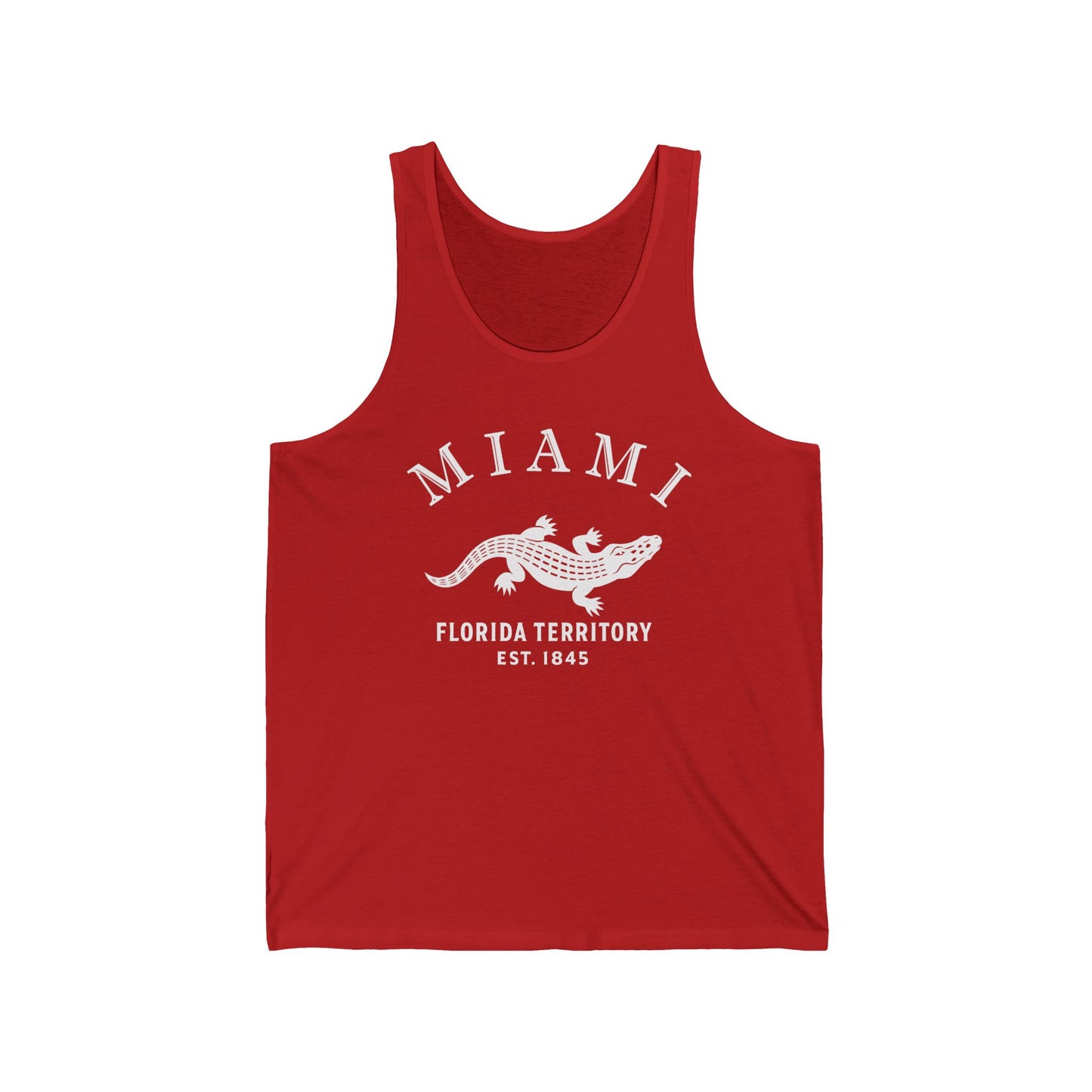
Miami Florida Vintage Retro Unisex Cotton Jersey Tank Top - White Logo

Miami Florida Vintage Retro Unisex Cotton Jersey Tank Top - White Logo

Regular price $28.00 USD
Regular price Sale price $28.00 USD
Sale
Shipping calculated at checkout.
Size
Color
Quantity
Unisex jersey tank made from lightweight Airlume combed and ring-spun cotton with a retail fit. Side-seam construction and self-fabric binding help it hold shape, with a tear-away label, and it runs true to size for adults. Solid colors are 100% cotton; select heather/prism shades may include cotton–poly or cotton–poly–rayon blends.

View full details

The Tequesta fished and hunted at the mouth of the Miami River for thousands of years before European contact. The Spanish came in 1513 with Juan Ponce de León, lost Florida to the British in 1763, took it back in 1783, and surrendered it to the United States in 1821; Florida became the 27th state on March 3, 1845. The American territorial era brought the Seminole Wars — Fort Dallas, on the north bank of the Miami River, was one of the military installations of that long campaign, and it was on the Fort Dallas land that Julia Tuttle would later build her city. William and Mary Brickell were already there when she arrived, trading on the south bank of the river; Mary Brickell became, after Tuttle, the Other Mother of Miami, and the Brickell name stayed on the downtown financial district south of the river.

Miami holds the world's largest concentration of Art Deco architecture. The Tequesta people lived at the mouth of the Miami River on Biscayne Bay for thousands of years before European contact. The Spanish came in 1513, the British in 1763, and the territory passed to the United States in 1821, with Florida becoming the 27th state on March 3, 1845. The modern city began with a Cleveland widow named Julia DeForest Tuttle, who in 1891 sold her late husband's iron foundry and bought 640 acres on the north bank of the Miami River, at the old Fort Dallas military site, and began a relentless campaign to convince the Standard Oil baron and Florida East Coast Railway builder Henry M. Flagler to extend his railroad south to the wilderness she could see from her porch. When the Great Freeze of 1894-1895 wiped out the citrus belt of central and northern Florida, Tuttle sent Flagler an orange blossom dispatched by courier as proof her south Florida coast had been spared. The order to extend the tracks came. On April 22, 1896, the first Florida East Coast Railway train rolled into the Miami River, and on July 28, 1896, 502 male residents met in a downtown pool hall and voted to incorporate the City of Miami; Julia Tuttle is the only woman ever to have founded a major American city, and Flagler's Royal Palm Hotel opened its doors at the river's mouth in January 1897. The 1920s land boom built three of the city's defining works of architecture, all in the space of about three years: James Deering's Vizcaya estate on Biscayne Bay in Coconut Grove (built 1914-1922 in the Italian Renaissance and Mediterranean Revival style by architect F. Burrall Hoffman with artistic director Paul Chalfin and the Colombian landscape architect Diego Suarez, designated a National Historic Landmark in 1994); the Freedom Tower on Biscayne Boulevard (opened July 26, 1925, designed by Schultze and Weaver as the Miami News Tower and modeled on the Giralda bell tower of the Cathedral of Seville, later the Cuban Refugee Center from 1962 to 1974 — the "Ellis Island of the South" — and designated a National Historic Landmark on October 6, 2008); and George Merrick's Coral Gables, the Mediterranean Revival planned city of 1925, with its 1924 Venetian Pool and its 1926 Schultze and Weaver Biltmore Hotel. Across the bay on the Miami Beach barrier island, between 1923 and 1943, eight hundred buildings went up in the Tropical Deco style that adapted Art Deco to a subtropical climate — pastel facades, eyebrow ledges, porthole windows, neon signage, nautical motifs — and the entire one-square-mile district was listed on the National Register of Historic Places on May 14, 1979, as the nation's first 20th-century urban historic district. Henry Hohauser's Colony Hotel of 1935 sits on Ocean Drive at the center of it. The Great Miami Hurricane of September 18, 1926, ended the land boom, and the city rebuilt through the 1930s under the same Tropical Deco vocabulary that defines South Beach today. On Biscayne Bay since the Tequesta.

Why People Visit Miami Florida

Miami offers the world's largest concentration of Art Deco architecture in the Miami Beach Historic District, the Italian Renaissance villa of Vizcaya on Biscayne Bay, the Schultze and Weaver Freedom Tower with its Giralda silhouette, George Merrick's 1925 Mediterranean Revival Coral Gables planned city, the long Cuban-American main street of Calle Ocho through Little Havana, the MiMo continuation up Collins Avenue from the Fontainebleau, and the bay and barrier-island geography that runs from Coconut Grove north through downtown to Bal Harbour. It is a coastal city that was incorporated by a Cleveland widow with an orange blossom and built three times in three short bursts since 1896. Magic City since 1896.

Miami Florida Merlin Classics retro vintage logo featuring Florida alligator motif with 1845 statehood date

Wear Local. Feed Local. Stay Classic.

Product FAQs

How does your sizing work?

Because items are made to order, we can’t accept returns for sizing or color choices. We do accept returns for defects, misprints, or shipping damage. Please review the detailed photos and descriptions before purchasing. Women’s fitted tees run small; if you prefer a looser fit, consider sizing up.

How do I send gifts?

All items ship without prices and include a simple packing slip for easy gifting. Enter the recipient’s shipping address and your billing address at checkout. Use your contact info to receive tracking updates. Orders typically arrive within 6–11 business days—please allow extra time for time-sensitive gifts.

How do I care for my item?

For apparel: wash cold, inside-out, with like colors; avoid bleach and high heat; tumble dry low or hang dry. For embroidery, iron inside-out to protect the stitching. See specific care instructions in product descriptions and also follow general best practices in caring for your items for long term enjoyment.

How are items made and when will they arrive?

We make each item on demand using premium blanks, embroidery, and soft-hand prints. Production usually takes 2–5 business days (excluding weekends and holidays). You’ll receive tracking once shipped. We currently ship to U.S. addresses via USPS, UPS, or FedEx. Most orders arrive within 6–11 business days.

What’s the return/exchange policy?

We accept returns for defects, misprints, or damage on arrival. Report issues within 14 days with photos and your order number, and we’ll replace or refund. Size or color changes aren’t supported after purchase, so please consult size charts before ordering if you are at all unsure.

Who are we?

Merlin Classics is a volunteer-run, AI-assisted apparel project celebrating timeless local style. Every item is made to order, and profits (revenue minus external product/marketing cost) support hunger-relief programs in the communities our collections spotlight. Classic looks, real local impact—every purchase helps.