


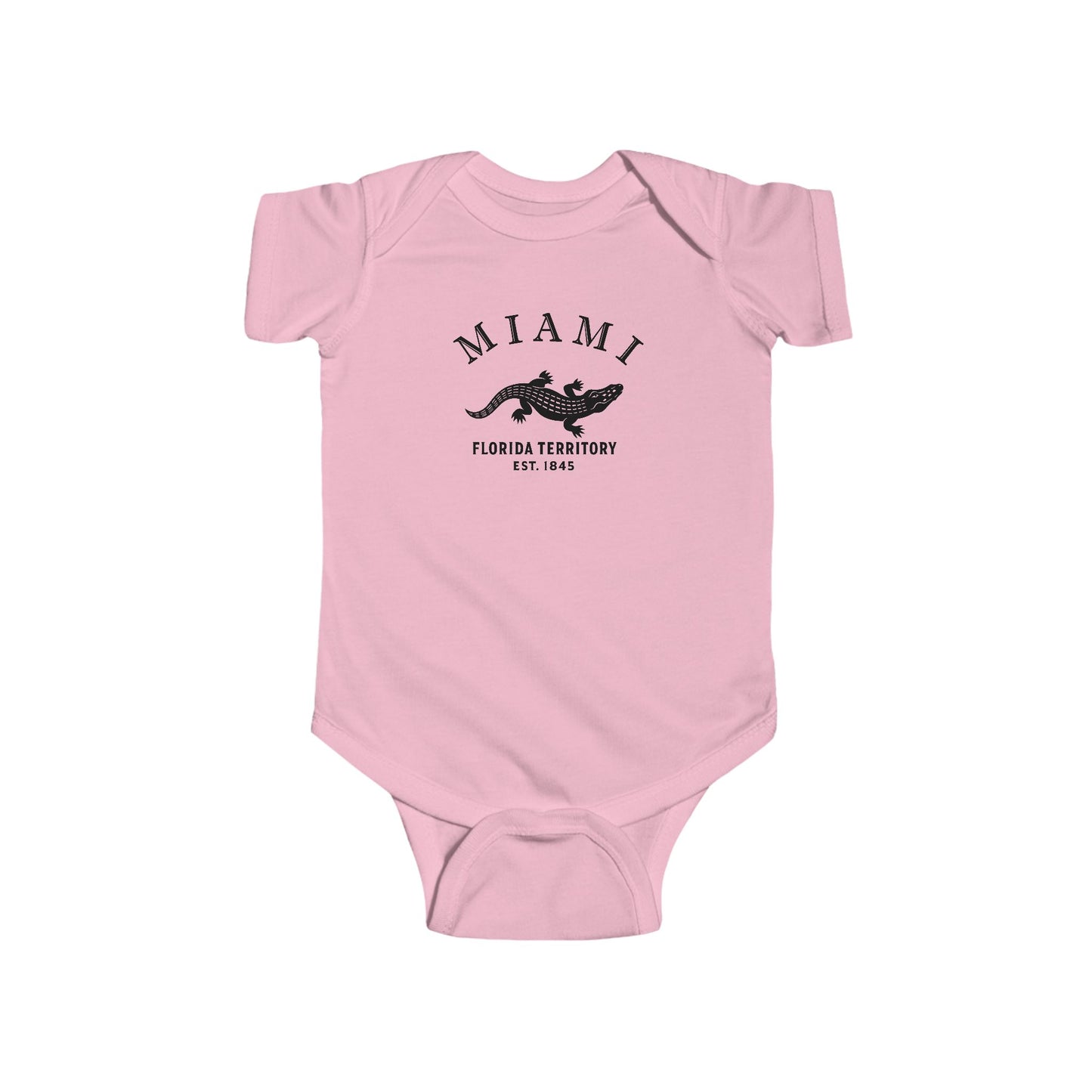


Our Miami retro logo uses the Florida alligator motif over "Florida - Est. 1845," emphasizing the state’s wild heart and its statehood year. Black-and-white styling mirrors citrus crate labels and old highway signage — rugged, timeless, retro in style — bridging Miami’s layered heritage: the Tequesta’s bay, Julia Tuttle’s orange blossom, the Deco boom, and Cuban Miami’s cafecito century. On merchandise it reads authentic and vintage — an emblem of Magic City pride.
What’s with the Orange Blossom? In the winter of 1894-95 the Great Freeze killed the citrus belt across central and northern Florida — and spared the wilderness at the mouth of the Miami River. Julia Tuttle, a Cleveland widow who had bought 640 acres at the old Fort Dallas military site, had spent years trying to convince the railroad baron Henry Flagler to extend his Florida East Coast Railway south to the shore she could see from her porch. Now she made sure proof reached him: the man Flagler sent south to investigate carried back an orange blossom, fresh and unfrozen, from her side of the freeze line — along with her offer of half her land for the railroad. The order to extend the tracks came. On April 22, 1896, the first scheduled passenger train rolled in to the Miami River, and on July 28, 1896, 502 voters met in a downtown pool hall and incorporated the City of Miami — making Julia Tuttle the only woman ever to have founded a major American city, in an era when she could not cast a vote in that pool hall herself. Flagler’s Royal Palm Hotel opened at the river’s mouth the following January, and the town grew so fast that visitors said it rose like magic. The nickname stuck: the Magic City.
Why People Visit Miami Florida
- Walk Calle Ocho in Little Havana — order a cafecito at a ventanita, watch the domino games at Máximo Gómez Park, and pick up pastelitos from a Cuban bakery.
- Stand before the Freedom Tower on Biscayne Boulevard, the 1925 landmark modeled on Seville’s Giralda that served as the Cuban Refugee Center from 1962 to 1974.
- Tour the 1916 Vizcaya estate and its gardens on Biscayne Bay in Coconut Grove — the boom era’s Italian Renaissance fantasy, now a museum.
- Drive the Mediterranean Revival streets of Coral Gables, George Merrick’s 1925 planned city, stroll Miracle Mile, and see the coral-rock Venetian Pool of 1924.
- See the murals of Wynwood, the warehouse district turned open-air gallery north of downtown.
- Take a boat tour of Biscayne Bay from Bayfront Park or the Miami River — the skyline from the water is the city’s best portrait.
- Cross the Rickenbacker Causeway to Key Biscayne for beaches, the Cape Florida lighthouse, and bay views back toward the city — with the stilt houses of Stiltsville standing offshore on the flats.
- Day-trip west to the Everglades or south toward Biscayne National Park — the wild tropical frame around the metropolis.
- Time a winter visit for the height of snowbird season, when the bay is at its bluest and the café windows never close.