


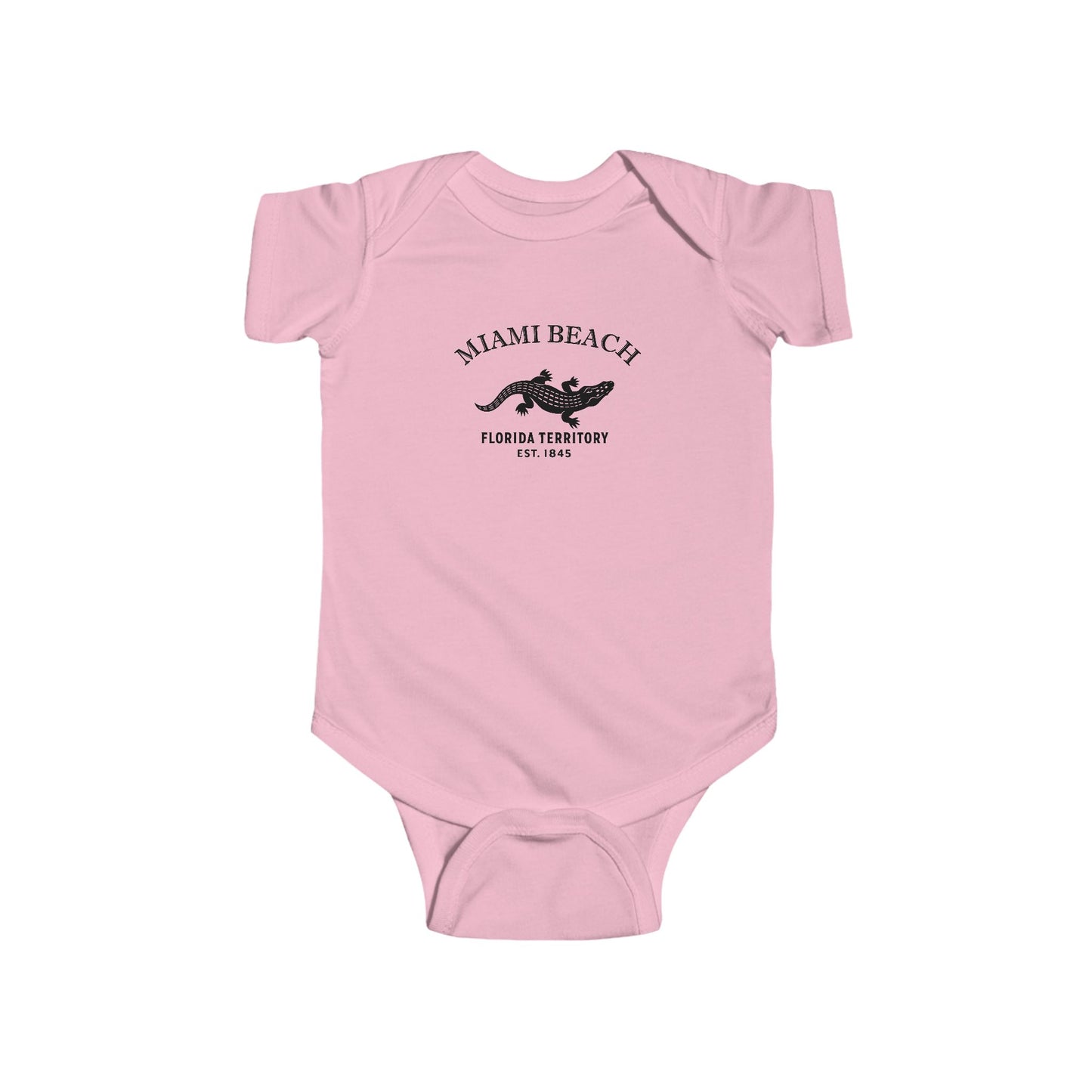


Our Miami Beach logo carries the Florida alligator over “Florida Territory · Est. 1845,” the year Florida became a state — the shared emblem of every Merlin Classics Florida town. Printed in clean retro black-and-white that reads like an old crate label, the alligator stands for Florida as a whole; what makes this one Miami Beach is everything behind it — the Art Deco strip and its neon, the candy-colored lifeguard towers, the man-made island, and the winter playground where the sand meets South Beach.
What’s with the Art Deco? Walk down Ocean Drive and the whole street looks like a 1930s daydream painted in sherbet — pastel hotels with rounded corners and racing stripes, porthole windows, and neon that comes alive at dusk. This is the Miami Beach Architectural District, the largest concentration of Art Deco buildings anywhere in the world: roughly eight hundred of them, packed into the blocks of South Beach. Most went up in the 1930s — small stucco hotels built cheap and optimistic during the Depression — in a local style so distinct it earned its own name: Tropical Deco, with nautical curves, shady “eyebrows” over the windows, and a palette borrowed from the sea and the sunset.
Why People Visit Miami Beach
Miami Beach rewards visitors who want style with their sand: the world’s great Art Deco strip, a wide Atlantic beach, walkable streets, and neon nights. Add the South Beach glow and the year-round Florida sun, and the man-made island makes an easy case for itself.
