


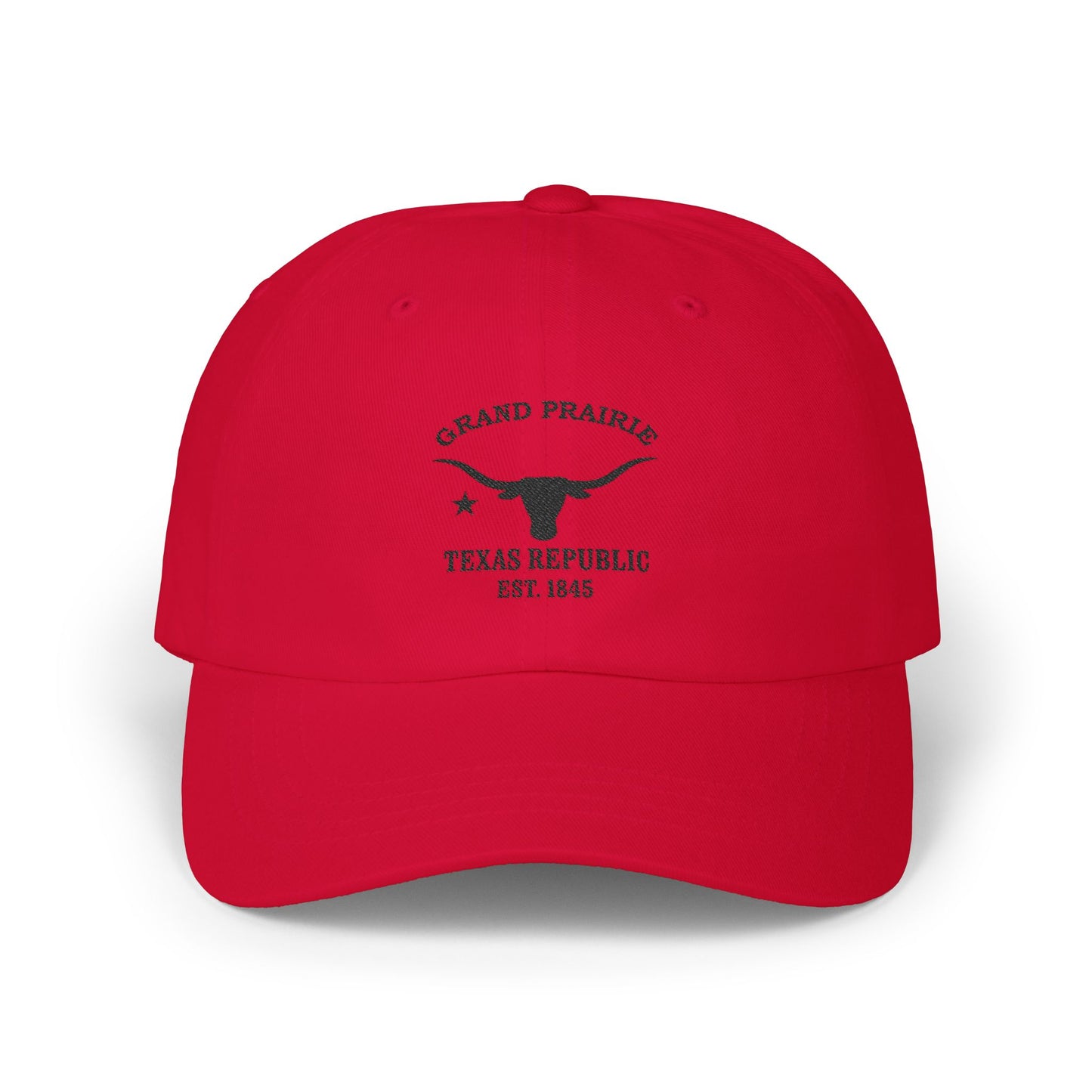
On the edge of the grand prairie — a railroad town between two cities that built fighter planes and runs racehorses. Grand Prairie sits squarely between Dallas and Fort Worth, on the eastern edge of the great Texas grassland that gave the city its name. It started as a rail stop called Dechman in 1863; the Texas & Pacific renamed it Grand Prairie in 1877. In World War II its plant turned out P-51 Mustang fighters and B-24 Liberator bombers, and today thoroughbreds run at Lone Star Park. Prairie, propellers, and post position — this page tells the story.
The land here was Peters' Colony prairie before the Civil War, a stretch of the great Texas grassland crossed by trading paths between Dallas and Fort Worth. In 1863 the settler Alexander McRae Dechman founded the community first known as Dechman; when the Texas & Pacific Railroad arrived in 1876 it became a depot town, and in 1877 it was renamed Grand Prairie for the grassland it sat on. The town incorporated in 1909, a farming and ranching crossroads on the rail line at the heart of what would become the Dallas-Fort Worth Metroplex.
Why People Visit Grand Prairie Texas
- Spend a day at Loyd Park on Joe Pool Lake, with trails, campsites, and boating.
- Catch live thoroughbred and quarter-horse racing at Lone Star Park during the spring and fall meets.
- Walk the historic downtown around the Texas & Pacific rail depot.
- Cool off at the Epic Waters indoor waterpark, or browse the weekend stalls at Traders Village.
- Take in the prairie horizon and the lakes that frame the city north and south.
