


More From Waiʻanae Hawaiʻi
-
Waianae Hawaii Vintage Retro Vinyl Sticker - Black Logo
Regular price From $6.00 USDRegular price -
Waianae Hawaii Vintage Retro Thank You Card Set - Black Logo
Regular price From $25.00 USDRegular price -
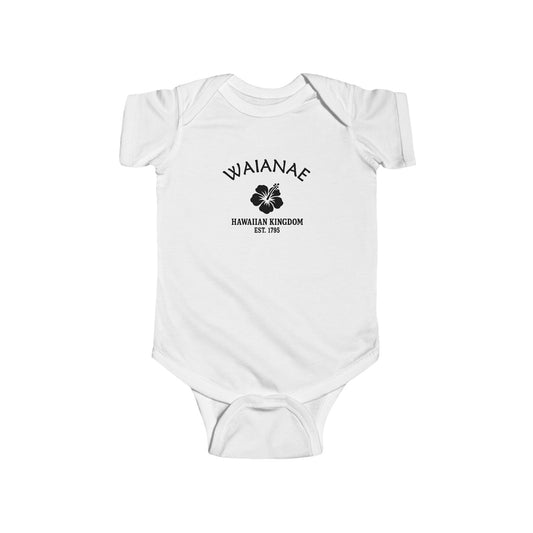
Waianae Hawaii Vintage Retro Cotton Jersey Baby Bodysuit - Black Logo
Regular price $26.00 USDRegular price -
Waianae Hawaii Vintage Retro Unisex Cotton Jersey Tank Top - Black Logo
Regular price $28.00 USDRegular price

The Mākaha era began in the 1930s when Honolulu surfers first ventured west to ride the leeward-coast waves, and accelerated in 1952 when John Lind's Waikīkī Surf Club and the Waiʻanae Lions Club organized the Mākaha International Surfing Championships. The first running of the contest at Mākaha Beach in 1953-1954 was the world's first international surfing competition; the event grew through the 1950s and 1960s into the unofficial world championships, drew thousands of spectators out to the Westside every November and December, ran on ABC's Wide World of Sports in 1962 as the first televised surf contest ever, and continued at Mākaha until 1971 — when global surf attention shifted to the North Shore breaks at Pipeline and Sunset Beach. Greg Noll caught what surfers of the era called the biggest wave ever ridden, at Mākaha, in 1969. The Mākaha-born lifeguard Richard "Buffalo" Keaulana — born 1934, with a royal genealogy that ran through Kamehameha I on his father's side and Kekaulike on his mother's side, and the 1960 Mākaha International champion — founded Buffalo's Big Board Surfing Classic at Mākaha Beach in 1977, featuring canoe-surfing, tandem surfing, bullyboarding, bodysurfing, and longboards, and the Classic still runs every February. Behind the surf, in Mākaha Valley, Kāneʻāki Heiau is one of the most thoroughly restored ancient heiau in Hawaiʻi — a wahi pana that the Bishop Museum restored across the 1970s and opened to respectful public visits Tuesday through Sunday in 1990. The heiau is sacred ground; visitors observe quietly.
The Waiʻanae moku — sometimes called Waiʻanae Moku rather than translated to "the Waiʻanae District" — is the leeward division of Oʻahu, running from Kahe in the south to Kaʻena Point at the westernmost tip of the island. The Waiʻanae ahupuaʻa, sitting between the Mākaha and Lualualei ahupuaʻa, was the Royal Center of the district in the late 1600s and 1700s, with numerous important heiau and an estimated 4,000 to 6,000 residents at the time of European contact. Captain Cook's Resolution and Discovery first sighted the Hawaiian Islands on January 18, 1778, and Kamehameha I completed the unification of the islands in 1795. Pōkaʻī Bay, the protected swimming bay at Waiʻanae, takes its name from the voyaging chief Pōkaʻī of Kahiki who, in Hawaiian tradition, brought niu (coconut) to the islands; the bay once held the great coconut grove Ka Uluniu o Pokaʻī, noted by Western sailors in the 1700s. On the peninsula at Pōkaʻī Bay sits Kūʻīlioloa Heiau, the three-platform navigation heiau dedicated to Kū in his dog form Kūʻīlioloa. The Hawaiian creation tradition places the birth of the demigod Māui on this coast.
Why People Visit Waiʻanae Hawaiʻi
- Watch the surf at Mākaha Beach Park — one of the original homes of big-wave surfing, with winter waves up to 25 feet off Mākaha Point. The 1953-1954 Mākaha International Surfing Championships were the world's first international surfing competition. Buffalo's Big Board Surfing Classic, founded by Buffalo Keaulana in 1977, runs every February. Powerful backwash and rip currents in winter; calmer water and good shore-side viewing in summer.
- Swim at Pōkaʻī Bay — the protected swimming bay at Waiʻanae, the safest swimming on the leeward coast, named for the voyaging chief Pōkaʻī of Kahiki who brought niu (coconut) to the Hawaiian Islands. The peninsula on the south side of the bay holds Kūʻīlioloa Heiau, the three-platform navigation heiau dedicated to Kū in his dog form; respect the site, do not climb the platforms.
- Visit Kāneʻāki Heiau in Mākaha Valley — one of the most thoroughly restored ancient heiau in Hawaiʻi, a wahi pana sacred site that the Bishop Museum restored in 1970 and opened to respectful public visits Tuesday through Sunday in 1990. Access through the Mākaha Valley road; check current visiting hours; this is sacred ground, observe quietly and follow posted respectful-access guidance.
- Hike toward Kaʻena Point State Park — the westernmost tip of Oʻahu, where the Waiʻanae and North Shore coasts meet, a seabird refuge and Hawaiian monk seal habitat, sacred in Hawaiian belief as the leaping place of souls. Walk in from the Waiʻanae side along the old Dillingham railroad bed.
- Look up at Mount Kaʻala — the 4,025-foot summit of the Waiʻanae Mountain Range, the highest peak on the island of Oʻahu, sacred in Hawaiian tradition and often cloud-shrouded. The summit access trail is challenging.
- Walk the Waiʻanae Small Boat Harbor on Pōkaʻī Bay — one of Oʻahu's principal commercial fishing harbors, with the ahi-tuna fleet and views toward the Waiʻanae Range.
- Stroll Mā'ili Beach Park — the long lawn and sandy beach park south of Waiʻanae along Farrington Highway.
- Drive Farrington Highway (Route 93) along the Waiʻanae moku from Nānākuli north through Mā'ili and Waiʻanae to Mākaha, with the Pacific on your left and the Waiʻanae Range on your right.
- Look for honu (Hawaiian green sea turtles) and Hawaiian monk seals along the leeward beaches — both protected; stay 50 feet away.
