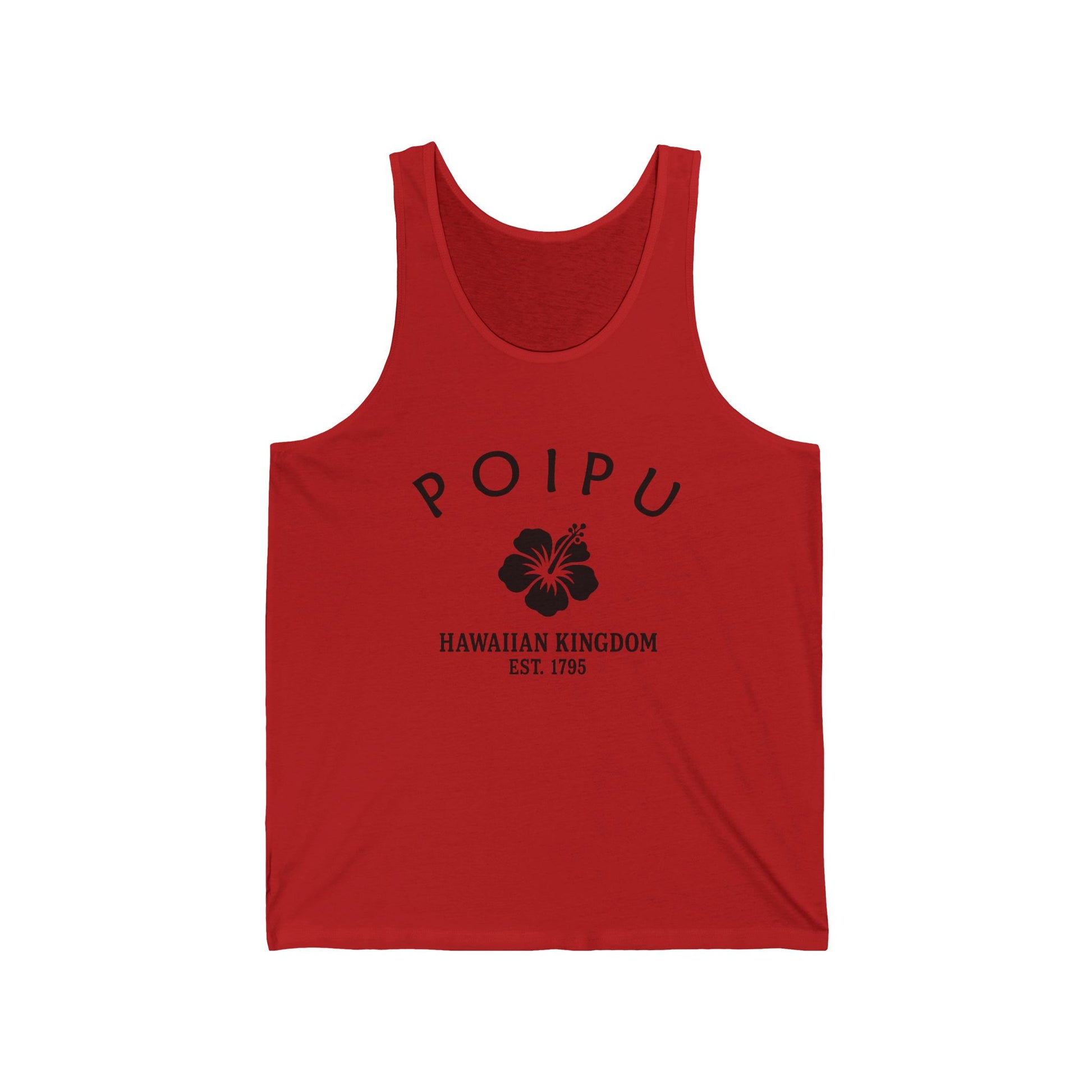


Our Poʻipū logo carries the Hawaiian hibiscus above “Hawaiian Kingdom — Est. 1795,” the shared retro emblem of our Hawaiʻi places, drawn in worn black-and-white like an old travel decal or crate label. The hibiscus is the through-line that links Poʻipū to every other Hawaiʻi town we make; what makes this one Poʻipū is everything around it — the Tree Tunnel, the crashing waves, the sugar town up the road, and the sunniest stretch of coast on the Garden Isle. Wear the crashing waves. Wear the south shore.
Just up the road from Poʻipū sits Kōloa, where in 1835 the firm of Ladd & Company opened Hawaiʻi's first commercially successful sugar plantation. It was the start of something far larger than one mill. Over the decades that followed, workers arrived from China, Japan, Korea, the Philippines, Portugal, and Puerto Rico to work the cane, and that gathering of arrivals became the foundation of modern Hawaiʻi's blended, multicultural community. Kōloa's plantation era ran for more than a century and a half, and you can still walk straight into it today.
Why People Visit Poʻipū
Poʻipū rewards visitors who want Hawaiʻi at its sunniest and most easygoing — a warm, protected coast with a century of south-shore history behind it. People come for Poʻipū Beach and the Spouting Horn, for the gardens and the golf, and for the plantation-era streets of Old Kōloa Town, where the Garden Isle's layered past sits a short walk from the sand.
