


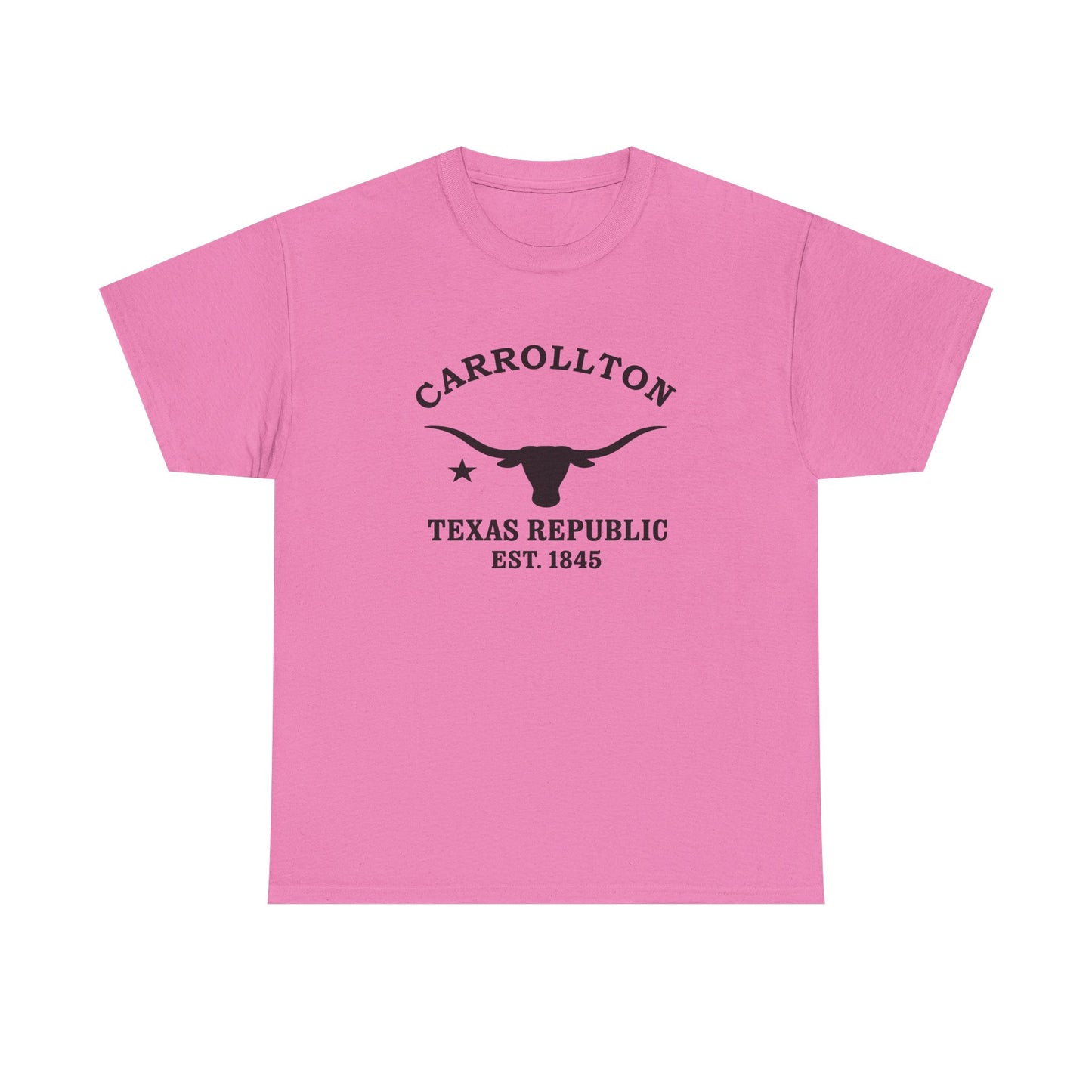
Our Carrollton logo carries the Texas longhorn and the Lone Star above 'Texas Republic — Est. 1845,' the shared retro emblem of our Texas towns; the longhorn stands for the cattle-and-cotton country the town was built to ship, the star for Texas itself, and 1845 marks the year Texas joined the Union as a state. Rendered distressed in black-and-white, like a brand on a crate or a stock pen, it ties Carrollton to every other Texas town we make. What makes this one Carrollton is the town behind the brand — the two Carrolltons, the rail crossing, and the silos on the Square.
Those first families — the Larners, the Furneaux, the Perrys, and a cluster of other English-rooted households sometimes called the 'English colony' — were after the same thing: the headrights the Peters Colony offered to anyone who would settle and improve the land. They found flat Blackland Prairie near the Elm Fork of the Trinity, good for cotton, corn, and grain, and they got to work. David Myers, also from Illinois, organized the first Baptist church in Dallas County in 1846; a community school followed around 1856 at the Union Baptist Church. For its first forty years Carrollton was a scattering of farms, gins, and mills, with a population you could count in the low hundreds.
Why People Visit Carrollton
Visitors come to Carrollton for the old railroad town inside the modern suburb — the Square, the silos, and the Switchyard — and stay for the food, the parks, and the easy reach of the whole Dallas-Fort Worth Metroplex. It is equal parts Texas heritage and present-day diversity, with vintage storefronts on one block and Korean bakeries on the next. Welcoming and well-connected, Carrollton rewards anyone curious about how a North Texas farm town became a three-county suburb without losing its center.
