


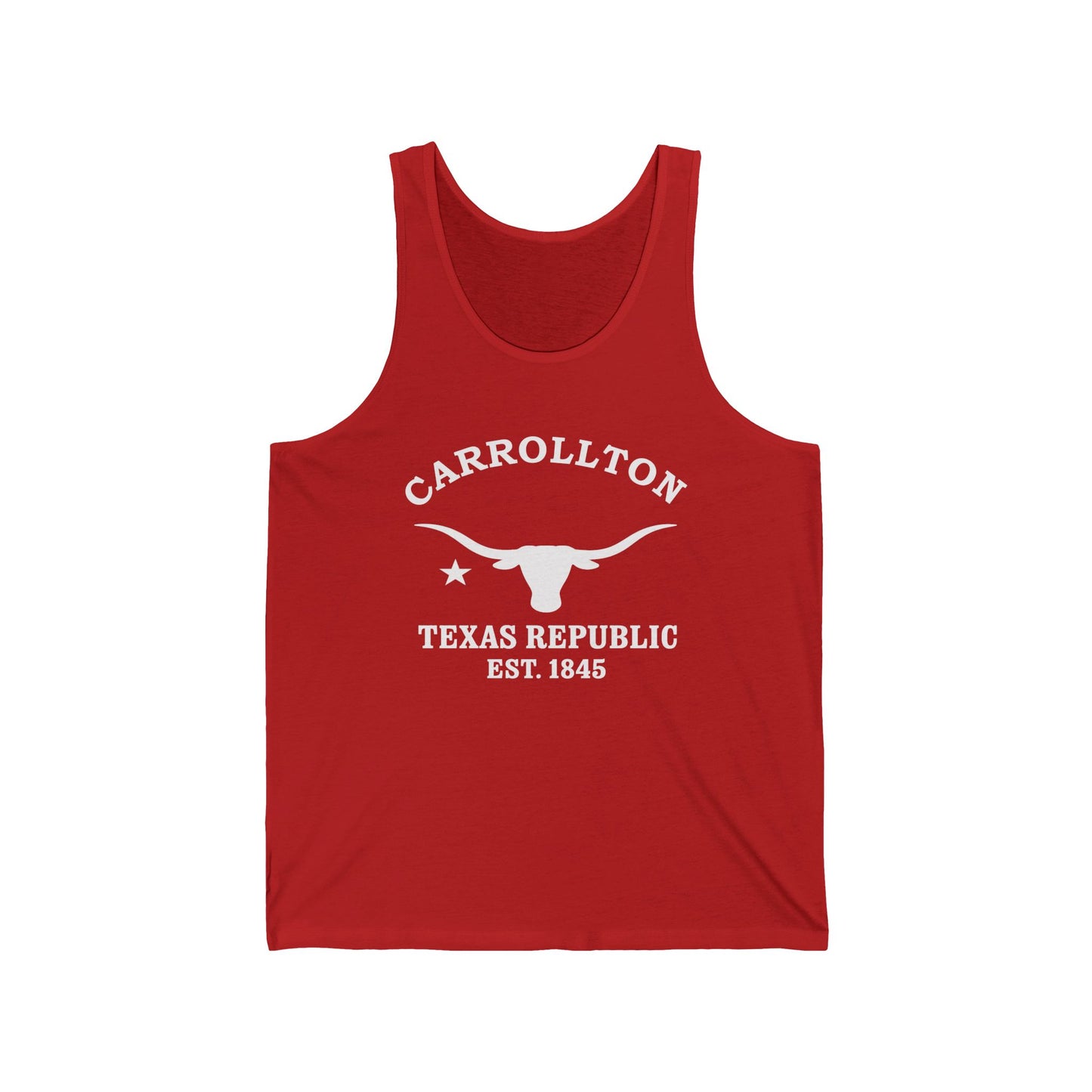


Our Carrollton logo carries the Texas longhorn and the Lone Star above 'Texas Republic — Est. 1845,' the shared retro emblem of our Texas towns; the longhorn stands for the cattle-and-cotton country the town was built to ship, the star for Texas itself, and 1845 marks the year Texas joined the Union as a state. Rendered distressed in black-and-white, like a brand on a crate or a stock pen, it ties Carrollton to every other Texas town we make. What makes this one Carrollton is the town behind the brand — the two Carrolltons, the rail crossing, and the silos on the Square.
Modern Carrollton is also one of the most Korean cities in Texas. Along Old Denton Road and through the north Dallas suburbs, a large Korean-American community has built groceries, bakeries, and barbecue restaurants thick enough that the area is sometimes called a hidden Koreatown — and in 2010 the city gave that everyday connection official shape by becoming a sister city of Guri, South Korea, just east of Seoul. The Festival at the Switchyard, begun the same year, brings the whole town back to the Square and the old rail yard each fall. A frontier farm town named twice-over for a Maryland signer now throws a street festival in the shadow of its grain silos, in one of the most diverse suburbs in North Texas.
Why People Visit Carrollton
Visitors come to Carrollton for the old railroad town inside the modern suburb — the Square, the silos, and the Switchyard — and stay for the food, the parks, and the easy reach of the whole Dallas-Fort Worth Metroplex. It is equal parts Texas heritage and present-day diversity, with vintage storefronts on one block and Korean bakeries on the next. Welcoming and well-connected, Carrollton rewards anyone curious about how a North Texas farm town became a three-county suburb without losing its center.
