


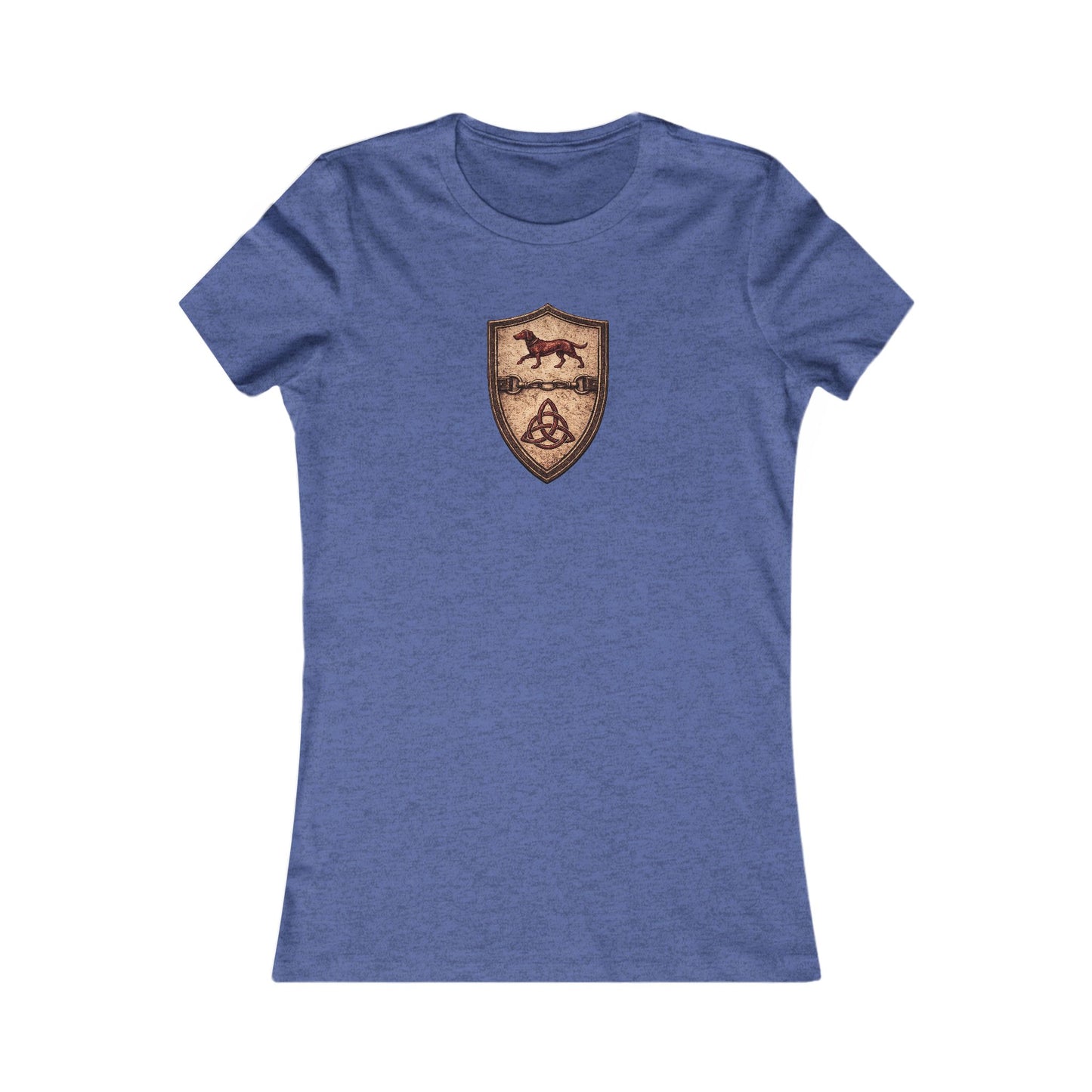
The triquetra at the foot of the shield is older than the other two emblems by several centuries. It appears in the marginalia of the Book of Kells around 800, in the carved stone crosses of Iona and Lindisfarne, and on the eleventh-century Funbo Runestones in Sweden. Originally a Celtic and Norse design motif from roughly 400 to 700, it was absorbed by Insular Christian art as a symbol of the Trinity — three persons, one substance, one unbroken loop. The geometry made the argument for perseverance: an endless line, three arcs returning to themselves with no beginning or end. Renaissance emblem books captioned interlaced devices of this kind nunquam frangitur, meaning never broken. When the heraldic tradition needed a symbol for the active form of constancy, the triquetra was already waiting, eight centuries old, ready for the work.
Each of the three words carries its own heraldic emblem, and each emblem has its own deep history. The talbot hound at the top of the shield is the symbol of fiducia, drawn from Isidore of Seville's Etymologiae of about 625, which described the dog as the most faithful creature alive — knowing its master after long absence, dying on its master's grave, refusing to be bought by any meat. The Aberdeen Bestiary repeated the claim around 1200, and by the reign of Edward III between 1327 and 1377, knights' funeral effigies often placed a hound at the feet as a heraldic statement of fidelity kept. John Talbot, 1st Earl of Shrewsbury, the English commander called "the English Achilles," bore the hound so prominently that it appears beside him in the presentation miniature of the Talbot Shrewsbury Book, given to Margaret of Anjou in 1445.
Why the Three Together
- Hound passant at the head — fiducia, the faithful watcher, drawn from Isidore and the bestiaries.
- Bridle and bit at the fess point — temperantia, the governing hand, codified by Ripa in 1593.
- Triquetra at the base — perseverantia, the unbroken loop, descended from Insular and Norse craft.
- The motto banners — read bottom-left to bottom-right to top, the order of moral development.
- The cape and the rearing horse — context, the unbridled power that the shield's emblem governs.
