Skip to product information
1 of 3

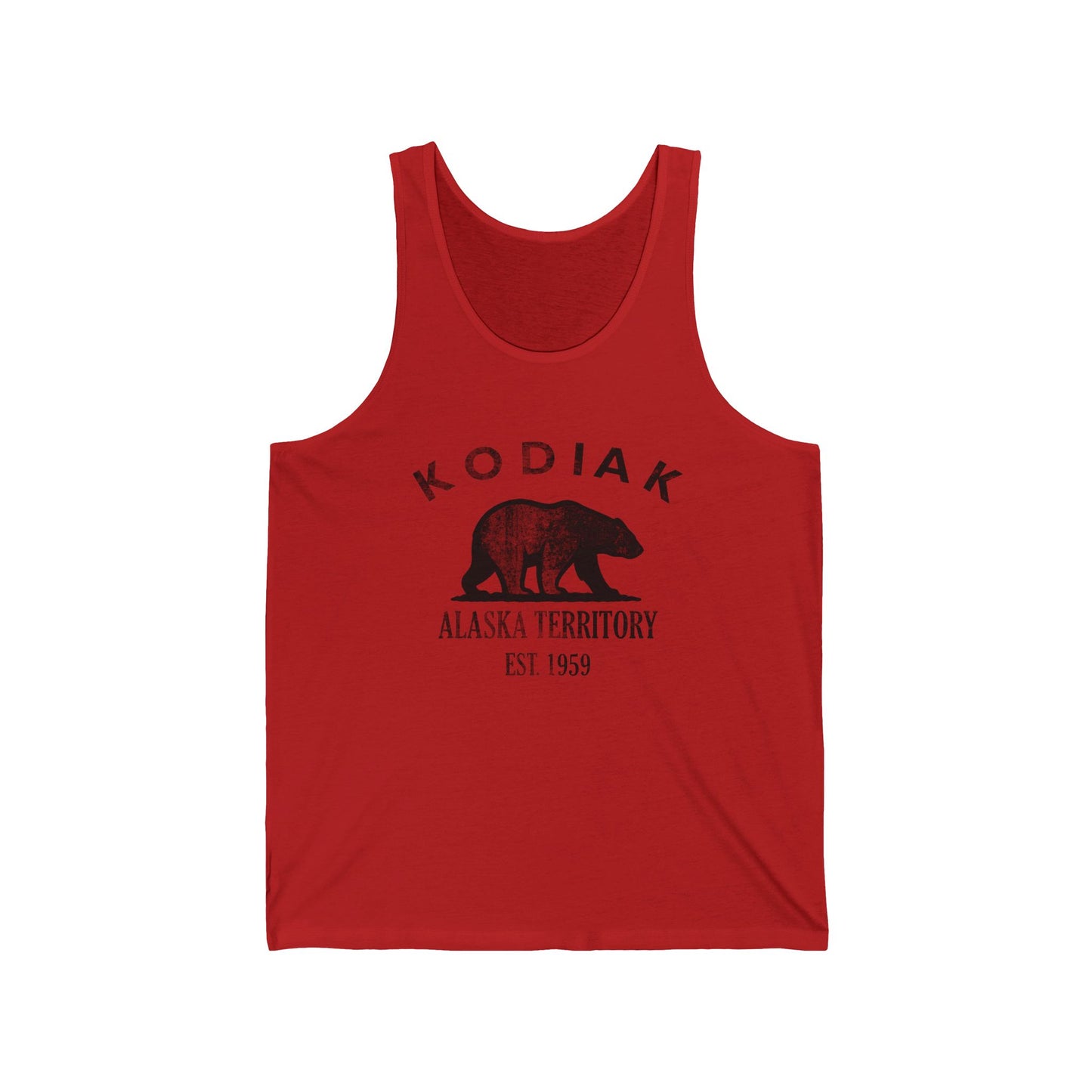
Kodiak Alaska Vintage Retro Unisex Cotton Jersey Tank Top - Black Logo

Kodiak Alaska Vintage Retro Unisex Cotton Jersey Tank Top - Black Logo

Regular price $28.00 USD
Regular price Sale price $28.00 USD
Sale
Shipping calculated at checkout.
Size
Color
Quantity
Unisex jersey tank made from lightweight Airlume combed and ring-spun cotton with a retail fit. Side-seam construction and self-fabric binding help it hold shape, with a tear-away label, and it runs true to size for adults. Solid colors are 100% cotton; select heather/prism shades may include cotton–poly or cotton–poly–rayon blends.

View full details

In 1792, the Russian fur trader Alexander Baranov moved the company headquarters from Three Saints Bay at the south end of the island to a deep, defensible harbor on the northeast coast and named the new settlement Pavlovskaya Gavan — Paul's Harbor. For the next twelve years, until the capital moved to Sitka in 1804, this was the capital of Russian Alaska — and Kodiak today remains the oldest continuously inhabited town in the state. The Alutiiq (Sugpiaq) people had lived on the Kodiak Archipelago for at least seven thousand years before the Russians arrived, and the Alutiiq name for Kodiak is Sun'aq. Vitus Bering and Aleksei Chirikov sighted the island in 1741 during the Second Kamchatka Expedition, Stepan Glotov became the first Russian to land in 1763, and Grigory Shelikhov — the "Russian Columbus" — founded the first permanent Russian settlement in North America at Three Saints Bay in 1784. The Russian Orthodox spiritual mission to North America arrived at Kodiak in 1794, and among the monks was Saint Herman of Alaska, who spent most of his life on nearby Spruce Island, founded an orphanage and school for Alutiiq children, and was canonized in 1970 as the first Orthodox saint of North America and the patron saint of Alaska. The Russian-American Company magazin — the warehouse Baranov's men built around 1808 to store sea otter pelts — stands today as the Baranov Museum, the oldest Russian-era wooden structure in Alaska, a National Historic Landmark since 1962. Holy Resurrection Cathedral, whose parish was founded in 1794, is the oldest Russian Orthodox parish in the Americas, and Saint Herman's relics rest there today. The United States purchased Alaska from Russia in 1867. On June 6-8, 1912, the Novarupta-Katmai eruption — the largest volcanic eruption of the twentieth century — buried Kodiak in up to eighteen inches of ash, and residents were evacuated to the U.S. Revenue Cutter Manning. On March 27, 1964 — Good Friday — the M9.2 Great Alaska Earthquake, the largest ever recorded in North America, sent a series of thirty-foot tsunami waves into the harbor that leveled downtown Kodiak, the fishing fleet, the canneries, fifteen lives, and eleven million dollars in damage. By 1968 the rebuilt fleet had made Kodiak the number-one U.S. fishing port by dollar value. The Coast Guard took over the former Naval Operating Base in 1971; Coast Guard Base Kodiak is today the largest U.S. Coast Guard installation by area. The island itself is 3,588 square miles, the second-largest in the United States after the Big Island of Hawaiʻi — green from spring through fall under sixty-seven inches of annual rain, and the only place on Earth where the Kodiak brown bear (Ursus arctos middendorffi) walks. They call it the Emerald Isle.

Kodiak is steeped in tales of giant bears, storms, and resilience. The Kodiak brown bear (Ursus arctos middendorffi) — known to the Alutiiq as taquka-aq — is the largest recognized subspecies of brown bear on Earth, found only on the Kodiak Archipelago, isolated from mainland brown bears for about twelve thousand years since the last ice age. Adult males can stand ten feet on their hind legs and weigh up to 1,500 pounds. Residents recount stories of fishermen surviving tsunamis or storms that sank ships. Local folklore blends Indigenous stories of respect for animals with mid-century maritime pride. These myths highlight a community defined by toughness, reverence for nature, and adaptability. From bears to tsunamis, Kodiak's stories emphasize endurance and resilience, qualities central to Alaska's frontier identity.

Why People Visit Kodiak Island Alaska

  • Tour the Baranov Museum (Kodiak History Museum) on Marine Way — the c. 1808 Russian-American Company magazin, the oldest Russian-era wooden structure in Alaska, National Historic Landmark since 1962, the oldest documented log structure on the West Coast of North America.
  • Visit Holy Resurrection Russian Orthodox Cathedral on Mission Road — the oldest Russian Orthodox parish in the Americas, founded 1794; the current building is a 1945 rebuild. Saint Herman of Alaska's relics rest inside. Photography respected; exterior blue-onion-domed silhouette is the iconic Kodiak skyline shot.
  • Tour the Alutiiq Museum and Archaeological Repository — opened 1995, preserving and interpreting more than 7,000 years of Alutiiq (Sugpiaq) culture, language, masks, and artifacts as an active cultural-revitalization institution.
  • Walk Fort Abercrombie State Historical Park — 1939 WWII coastal artillery emplacements and observation posts in dense spruce forest with dramatic ocean views, the location of the first secret radar installation in Alaska.
  • Watch the working St. Paul Harbor — Kodiak's commercial fishing fleet at the heart of one of the top U.S. fishing ports by dollar value: seiners, longliners, crabbers, halibut boats.
  • Drive past Coast Guard Base Kodiak — the largest U.S. Coast Guard installation by area at approximately 23,000 acres; not visitor-accessible, but the silhouette is part of every Kodiak day.
  • Climb Pillar Mountain — the 1,270-foot peak directly above downtown, site of the Pillar Mountain Wind Farm and the city's signature visual backdrop.
  • Book a bear-viewing flight or charter into the Kodiak National Wildlife Refuge — 1.9 million acres covering roughly two-thirds of the island, the only habitat on Earth of the Kodiak brown bear. June through September is the peak window when bears congregate at salmon streams.
  • Take a Spruce Island day trip — Saint Herman of Alaska's monastic home for nearly four decades; reachable from Kodiak by small boat.
  • Sport fish for salmon, halibut, Pacific cod, or rockfish out of St. Paul Harbor — all five Pacific salmon species run Kodiak waters in summer.
  • Drive south to Chiniak — the road system out of Kodiak runs about 45 miles, mostly along coast, through spruce forest with bay views the whole way.
  • Ferry to or from Homer on the Alaska Marine Highway — the ten-hour Shelikof Strait crossing through the heart of the Aleutian-arc geography.

Kodiak Island Alaska Merlin Classics retro vintage logo featuring distressed Alaska bear motif with 1959 Alaska statehood date

Wear Local. Feed Local. Stay Classic.

Product FAQs

How does your sizing work?

Because items are made to order, we can’t accept returns for sizing or color choices. We do accept returns for defects, misprints, or shipping damage. Please review the detailed photos and descriptions before purchasing. Women’s fitted tees run small; if you prefer a looser fit, consider sizing up.

How do I send gifts?

All items ship without prices and include a simple packing slip for easy gifting. Enter the recipient’s shipping address and your billing address at checkout. Use your contact info to receive tracking updates. Orders typically arrive within 6–11 business days—please allow extra time for time-sensitive gifts.

How do I care for my item?

For apparel: wash cold, inside-out, with like colors; avoid bleach and high heat; tumble dry low or hang dry. For embroidery, iron inside-out to protect the stitching. See specific care instructions in product descriptions and also follow general best practices in caring for your items for long term enjoyment.

How are items made and when will they arrive?

We make each item on demand using premium blanks, embroidery, and soft-hand prints. Production usually takes 2–5 business days (excluding weekends and holidays). You’ll receive tracking once shipped. We currently ship to U.S. addresses via USPS, UPS, or FedEx. Most orders arrive within 6–11 business days.

What’s the return/exchange policy?

We accept returns for defects, misprints, or damage on arrival. Report issues within 14 days with photos and your order number, and we’ll replace or refund. Size or color changes aren’t supported after purchase, so please consult size charts before ordering if you are at all unsure.

Who are we?

Merlin Classics is a volunteer-run, AI-assisted apparel project celebrating timeless local style. Every item is made to order, and profits (revenue minus external product/marketing cost) support hunger-relief programs in the communities our collections spotlight. Classic looks, real local impact—every purchase helps.