


This has always been a crossroads. The Tanana River Valley is Athabascan homeland, and the route through it became the Valdez-to-Fairbanks Trail in the early 1900s, carrying gold-seekers and freight between the coast and the Interior. A telegraph station went up in 1904; roadhouses followed to feed and shelter the travelers, including Sullivan Roadhouse in 1905 and Rika's Roadhouse around 1909, the latter run for decades by the Swedish immigrant Rika Wallen and now the centerpiece of Big Delta State Historical Park. In the 1920s the government chose the Delta country for a buffalo-importation experiment, trucking plains bison up from Montana — and the free-roaming herd stuck, giving the place its first name: Buffalo Center.
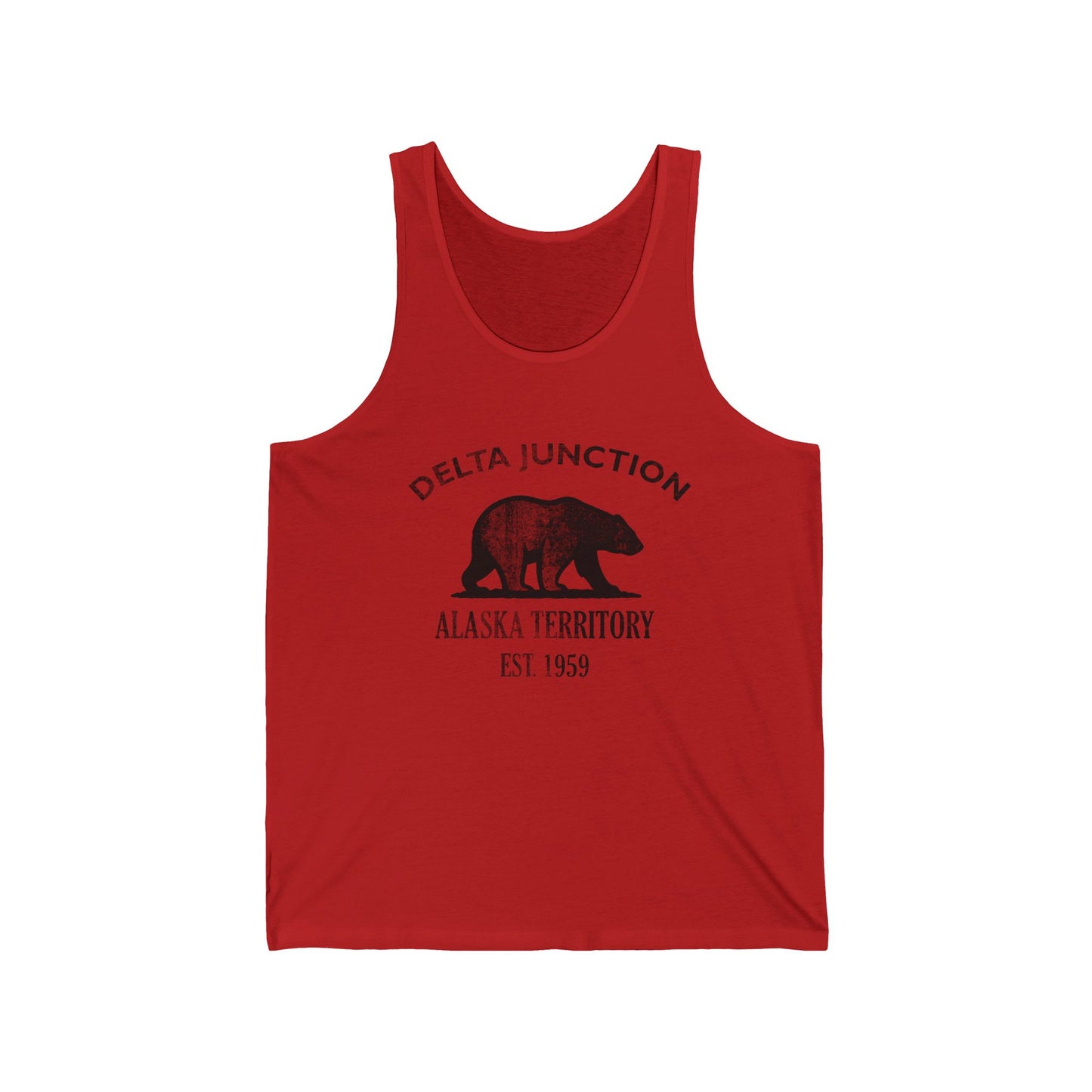
Our Delta Junction logo carries Alaska's distressed bear over "1959," the year of statehood and the shared emblem of every Merlin Classics Alaska town. The bear is the Last Frontier in shorthand — wilderness, toughness, the wide Interior — printed black-and-white with the worn look of a crate stamp or an outfitter's brand. What makes this one Delta Junction is the place behind it: the end of the Alaska Highway, the buffalo herd, the Tanana Valley under three ranges. On a tee or a cap it reads less like a souvenir and more like a piece of the Interior — worn plain.
Why People Visit Delta Junction Alaska
- Get your photo and certificate at the End of the Alaska Highway, Milepost 1422, at the Triangle.
- Visit Big Delta State Historical Park and Rika's Roadhouse (1909) on the Tanana River.
- Tour Sullivan Roadhouse, among the oldest in Interior Alaska, by the visitor center.
- Watch for the free-roaming Delta bison herd on the Delta Bison Range.
- Fish and camp at Quartz Lake, and catch the Deltana Fair in late July.
