


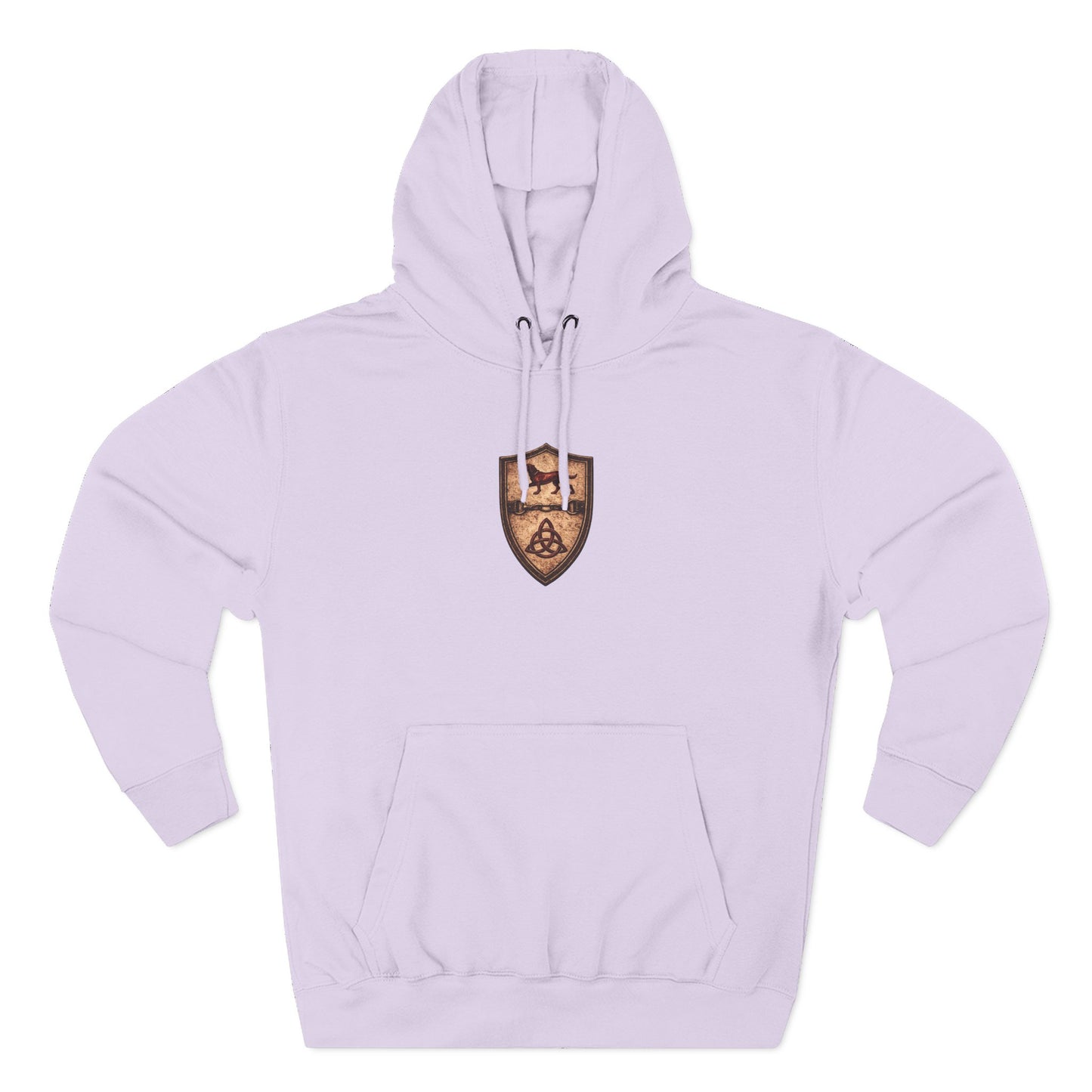
The triquetra at the foot of the shield is older than the other two emblems by several centuries. It appears in the marginalia of the Book of Kells around 800, in the carved stone crosses of Iona and Lindisfarne, and on the eleventh-century Funbo Runestones in Sweden. Originally a Celtic and Norse design motif from roughly 400 to 700, it was absorbed by Insular Christian art as a symbol of the Trinity — three persons, one substance, one unbroken loop. The geometry made the argument for perseverance: an endless line, three arcs returning to themselves with no beginning or end. Renaissance emblem books captioned interlaced devices of this kind nunquam frangitur, meaning never broken. When the heraldic tradition needed a symbol for the active form of constancy, the triquetra was already waiting, eight centuries old, ready for the work.
The phrase came together slowly. Fiducia entered Latin in the first century B.C. as a Roman legal term — a trust in property held by one party for the benefit of another. By the time Augustine of Hippo wrote in the early fifth century, the word had migrated from contract law to the disposition of the soul, meaning the trust a man places in God, in his lord — the mutual oath at the heart of the feudal system — and in the bonds he has sworn. Perseverantia took longer. Augustine rehabilitated it as a virtue in his last works, arguing it was a continuing grace rather than mere stubbornness. Temperantia was the oldest as a named virtue, descending from Plato and Aristotle through Cicero into the Christian moral vocabulary, where Aquinas placed it among the four cardinal pillars of a just life.
Why the Three Together
- Hound passant at the head — fiducia, the faithful watcher, drawn from Isidore and the bestiaries.
- Bridle and bit at the fess point — temperantia, the governing hand, codified by Ripa in 1593.
- Triquetra at the base — perseverantia, the unbroken loop, descended from Insular and Norse craft.
- The motto banners — read bottom-left to bottom-right to top, the order of moral development.
- The cape and the rearing horse — context, the unbridled power that the shield's emblem governs.
