








The city that replaced the Lock City is the one you see from the train. From the 1960s on, Stamford cleared and rebuilt its downtown and courted the corporations leaving New York, and they came; the skyline of office towers along Washington Boulevard and Tresser Boulevard is a product of that half-century. Metro-North’s New Haven Line makes Stamford station one of the busiest stops between Grand Central and Boston, and a great many people who live here spend their weekdays forty-five minutes west. By the 2020 census Stamford had passed New Haven to become Connecticut’s second-largest city, after Bridgeport, and among the largest in the state by land area. It is also, still, a harbor town: Cove Island, Cummings Park, West Beach and the marinas at Harbor Point face the Sound exactly where Turner’s deed said they would.
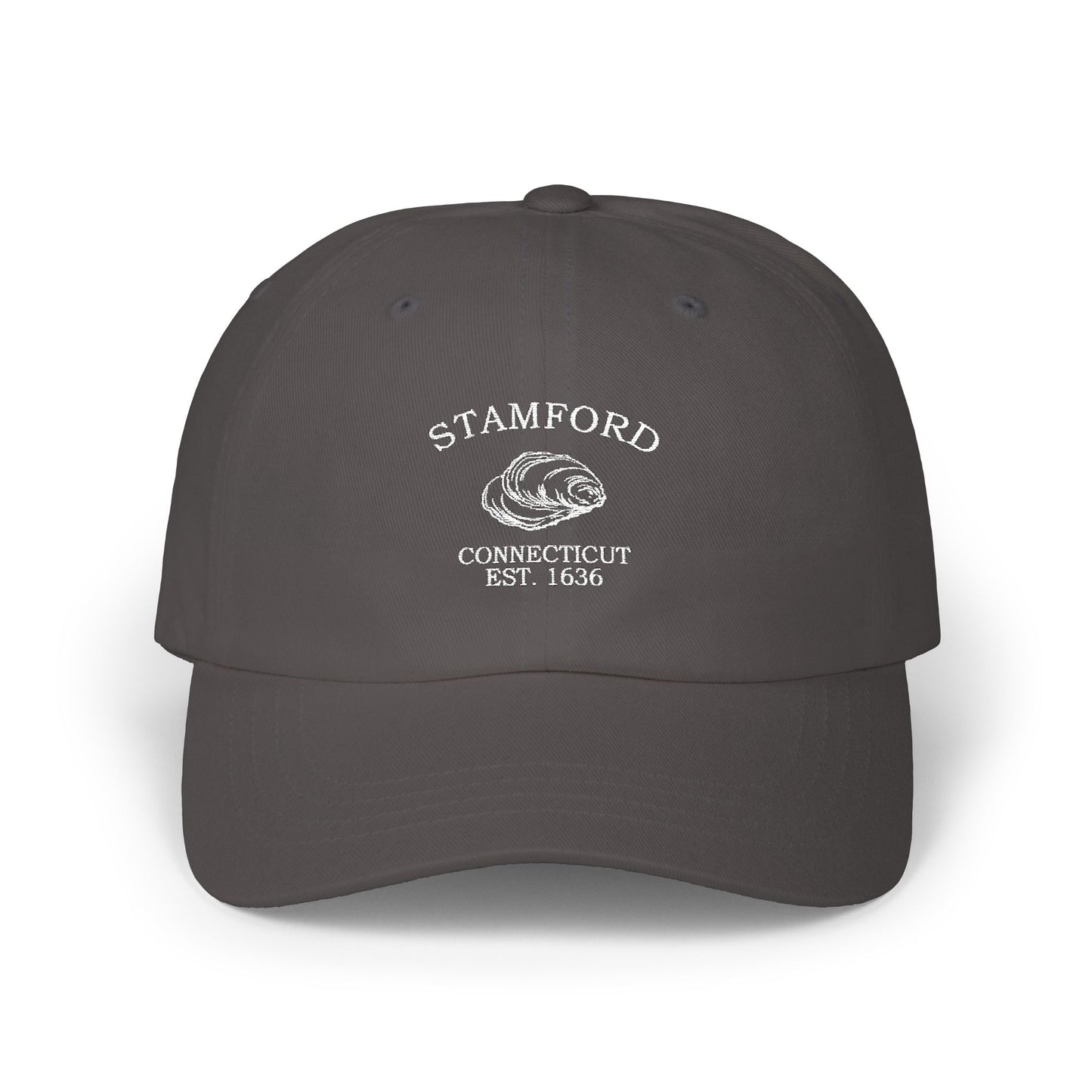
Our Stamford design carries an oyster shell beneath an arched STAMFORD and the line Connecticut · Est. 1636, printed in a worn, woodcut style. The oyster is Long Island Sound itself — the shellfish water this harbor town was built beside — and the 1636 date marks Connecticut's colonial founding. It reads like an old harbor-crate stamp: not the commuter-rail Stamford of the timetables, but Rippowam on the Sound, the colonial port under a modern city. This season the emblem shares the collection with the LBD Harbor Witch, drawn for the 1692 trial in a little black dress on a foggy Stamford dock: nobody in 1692 looked like her, because the accused never looked like witches. They looked like the people next door.
Why People Visit Stamford, CT
Stamford balances harbor and city — sailboats on the Sound, a downtown skyline, and four centuries of history from Rippowam to the rail line. It is a Gold Coast harbor town an hour from Manhattan, with the water, the parks, and that one-of-a-kind church on the hill. Increasingly it is also a town with a story to tell: the one that was asked to hang its witches in 1692 and signed a petition instead.
