


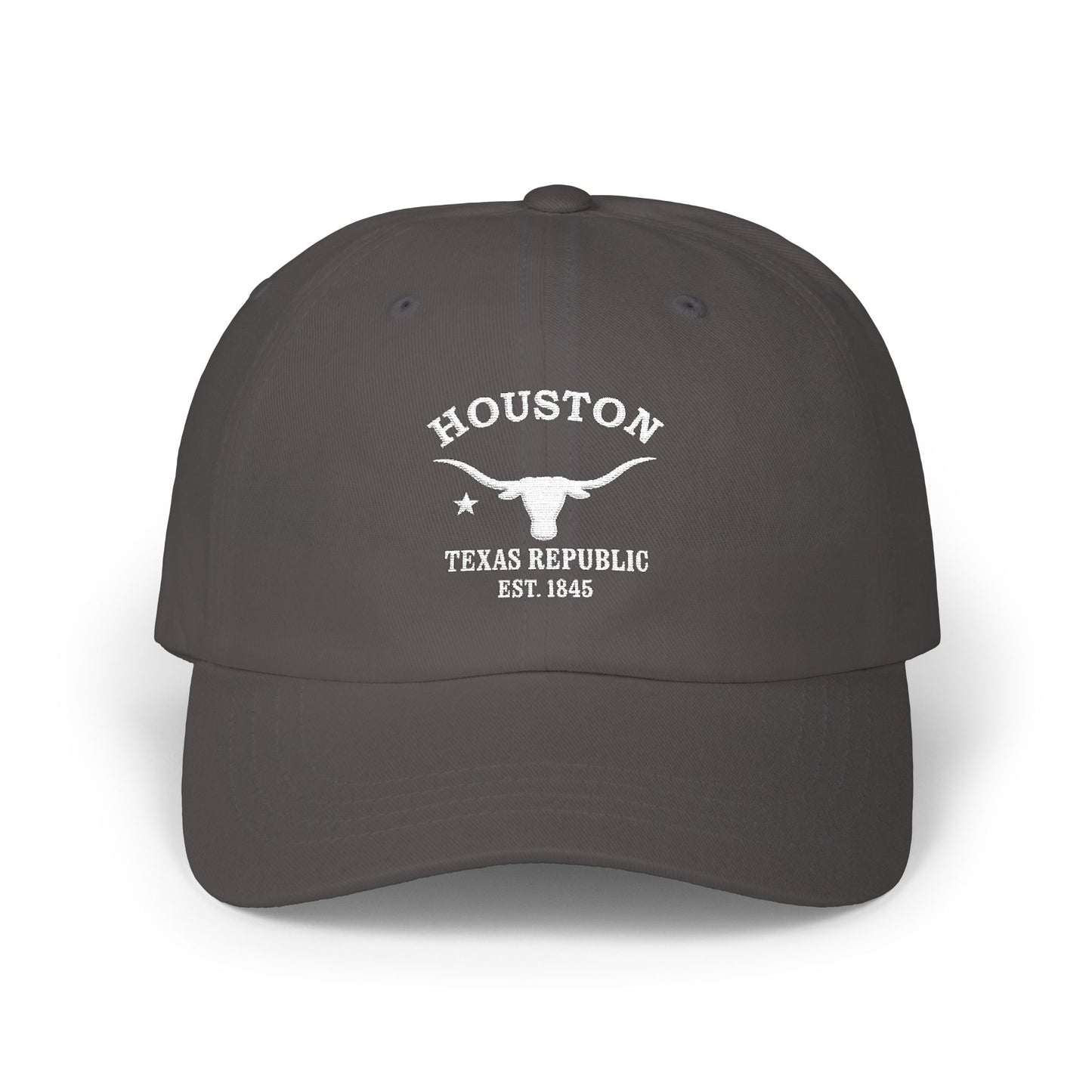
Today Houston is Texas's largest city and a hub of energy, aerospace, and culture. Its story blends bayou grit, oil wealth, and suburban optimism with space-age ambition. Our Houston designs celebrate this layered identity, pairing the longhorn and Lone Star with vintage styling. They invite you to explore the Houston collection and carry forward a reminder of resilience and ambition. Retro in tone, the motif honors Houston's roots and its evolution into a global city, perfectly reflecting Texas strength and independence. Explore Houston's collection and share in a story of frontier grit and innovation.
Houston grew rapidly after its founding, serving as the Republic of Texas capital and later thriving through railroads and cotton trade. The twentieth century brought oil discoveries, ship channel expansion, and aerospace leadership. By the 1950s and 1960s, Houston was booming: suburban neighborhoods spread outward, highways connected the city, and NASA's Johnson Space Center earned global fame. This timeline highlights Houston's relentless growth, balancing frontier resilience with modern innovation. From bayou settlement to "Space City," Houston epitomized Texas's spirit of ambition and adaptability, making it both an industrial powerhouse and a symbol of Lone Star resilience.
Why People Visit Houston Texas
Houston offers space heritage, Texas Revolution history, world-class museums, bayou parks, and one of the most diverse food scenes in the country, all in a working metropolis along the Gulf Coast. Visitors come for Mission Control and Space Center Houston, the San Jacinto monument and battleground, the museum district, the rodeo in March, the bayou trails, and the simple scale of a 666-square-mile city that runs from skyline to ship channel to NASA. It is sprawling, layered, and unlike any other city in America.
