


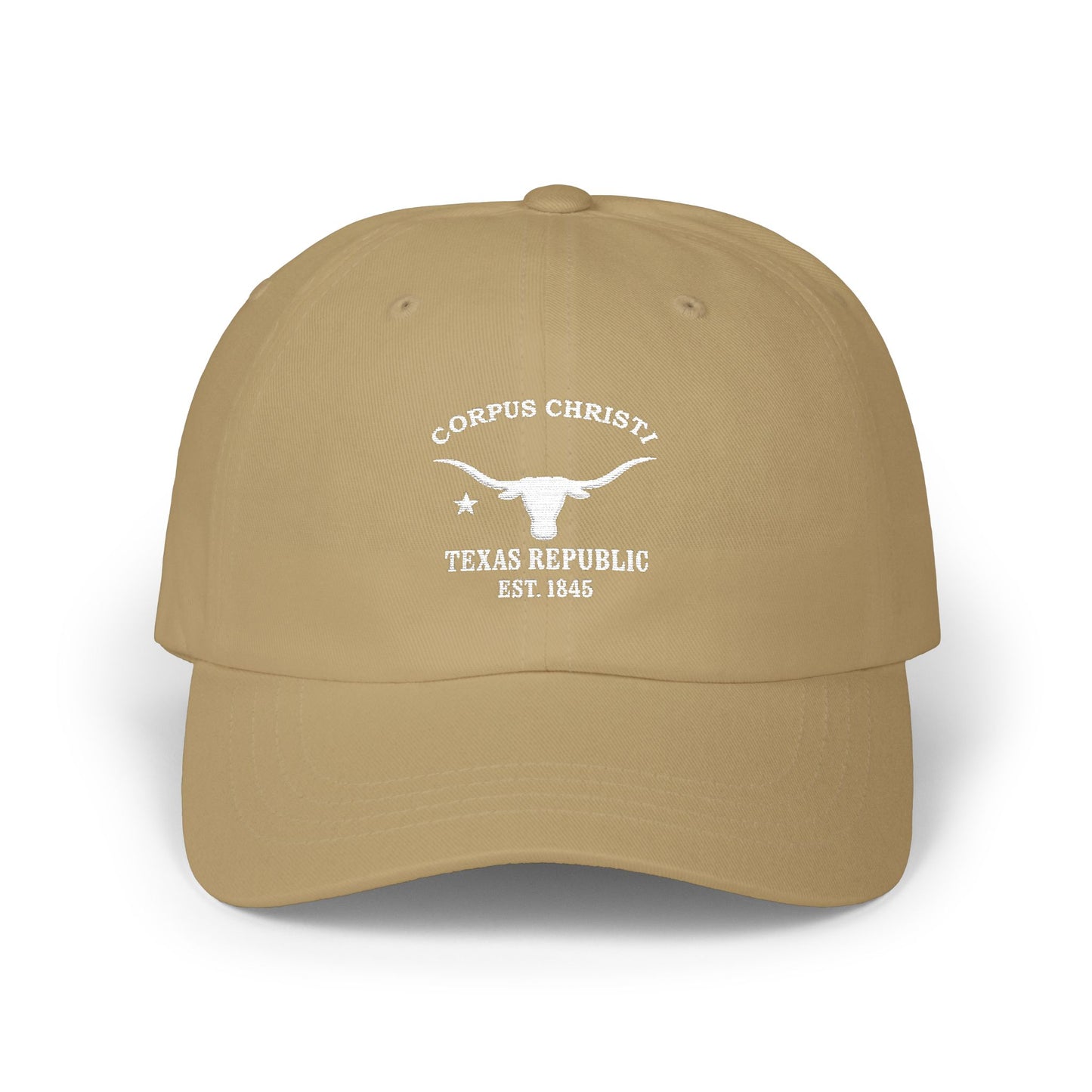






Our Corpus Christi logo carries the same emblem every Merlin Classics Texas place wears — a Texas longhorn and the Lone Star, above "Texas Republic, Est. 1845," rendered in hand-printed black and white with a worn, vintage feel. The longhorn and star are the Texas mark, the through-line that ties Corpus Christi to every other Texas place we make. What makes this one Corpus Christi is everything around it: the Blue Ghost on the bay, the wild beaches of Padre, the Gulf wind that never quits. On a tee or a cap it reads less like a souvenir and more like a piece of the South Texas coast — Est. 1845, worn plain.
The twentieth century made Corpus Christi a port, a Navy town, and a resort all at once. Refineries and the petrochemical trade grew along the ship channel, the Naval Air Station trained aviators by the thousands, and the bayfront filled with the miradores, the seawall, and the beaches that drew Texans to the coast. In 1962 Congress set aside Padre Island National Seashore, and in 1992 the USS Lexington came home to the bay as a museum. The Sparkling City also became a capital of Tejano music — and honors its most beloved voice, Selena, the Queen of Tejano music, at the bayfront Mirador de la Flor.
Why People Visit Corpus Christi Texas
Corpus Christi draws people who love the water, the wind, and a deep streak of history on the same coast. It is the Sparkling City by the Sea — home of a WWII carrier you can walk, the longest wild beach in America, a leading Gulf-coast port, and a proud Tejano-cultural heart. Visitors come for the rare combination: a working bayfront, barrier-island shore, the steady Gulf wind that made the bay a windsurfing capital, and the Blue Ghost riding at anchor over it all.
