


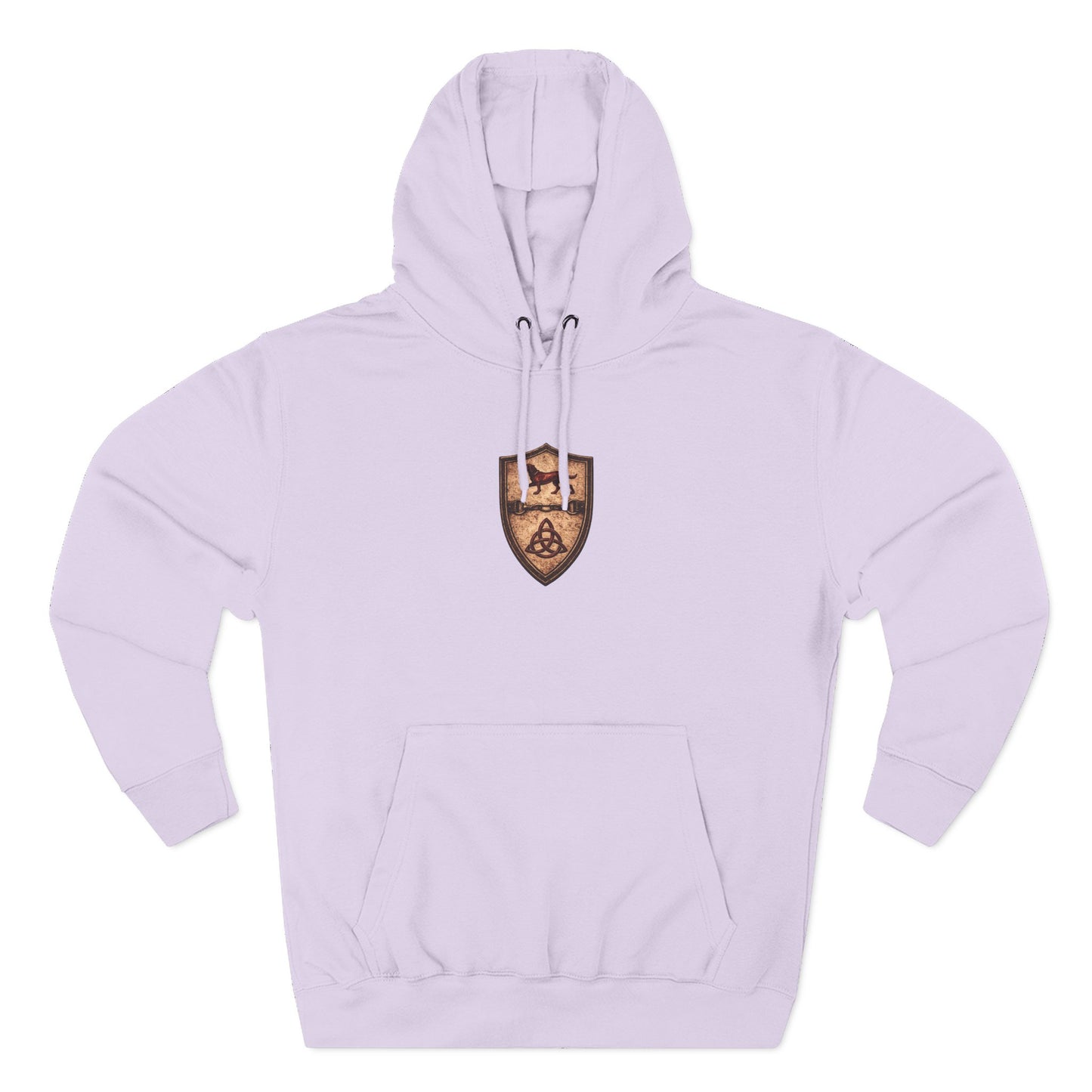
By the high medieval period the three words had been put to work on shields, walls, and the inside flaps of psalters. Bernard of Clairvaux, abbot of Clairvaux from 1115 to 1153, preached on perseverance for forty years and on trust for nearly as long. Thomas Aquinas, writing the Secunda Secundae of the Summa Theologiae between 1271 and 1272, argued that temperance was the virtue that kept the others from collapsing into their own excess. Without it, fortitude becomes recklessness, justice becomes cruelty, and prudence becomes mere cunning. More than a century later, Christine de Pizan put the same argument more plainly in her court treatises: temperance is the bridle on every other good. The metaphor would last another four hundred years.
Each of the three words carries its own heraldic emblem, and each emblem has its own deep history. The talbot hound at the top of the shield is the symbol of fiducia, drawn from Isidore of Seville's Etymologiae of about 625, which described the dog as the most faithful creature alive — knowing its master after long absence, dying on its master's grave, refusing to be bought by any meat. The Aberdeen Bestiary repeated the claim around 1200, and by the reign of Edward III between 1327 and 1377, knights' funeral effigies often placed a hound at the feet as a heraldic statement of fidelity kept. John Talbot, 1st Earl of Shrewsbury, the English commander called "the English Achilles," bore the hound so prominently that it appears beside him in the presentation miniature of the Talbot Shrewsbury Book, given to Margaret of Anjou in 1445.
Why the Three Together
- Hound passant at the head — fiducia, the faithful watcher, drawn from Isidore and the bestiaries.
- Bridle and bit at the fess point — temperantia, the governing hand, codified by Ripa in 1593.
- Triquetra at the base — perseverantia, the unbroken loop, descended from Insular and Norse craft.
- The motto banners — read bottom-left to bottom-right to top, the order of moral development.
- The cape and the rearing horse — context, the unbridled power that the shield's emblem governs.
