


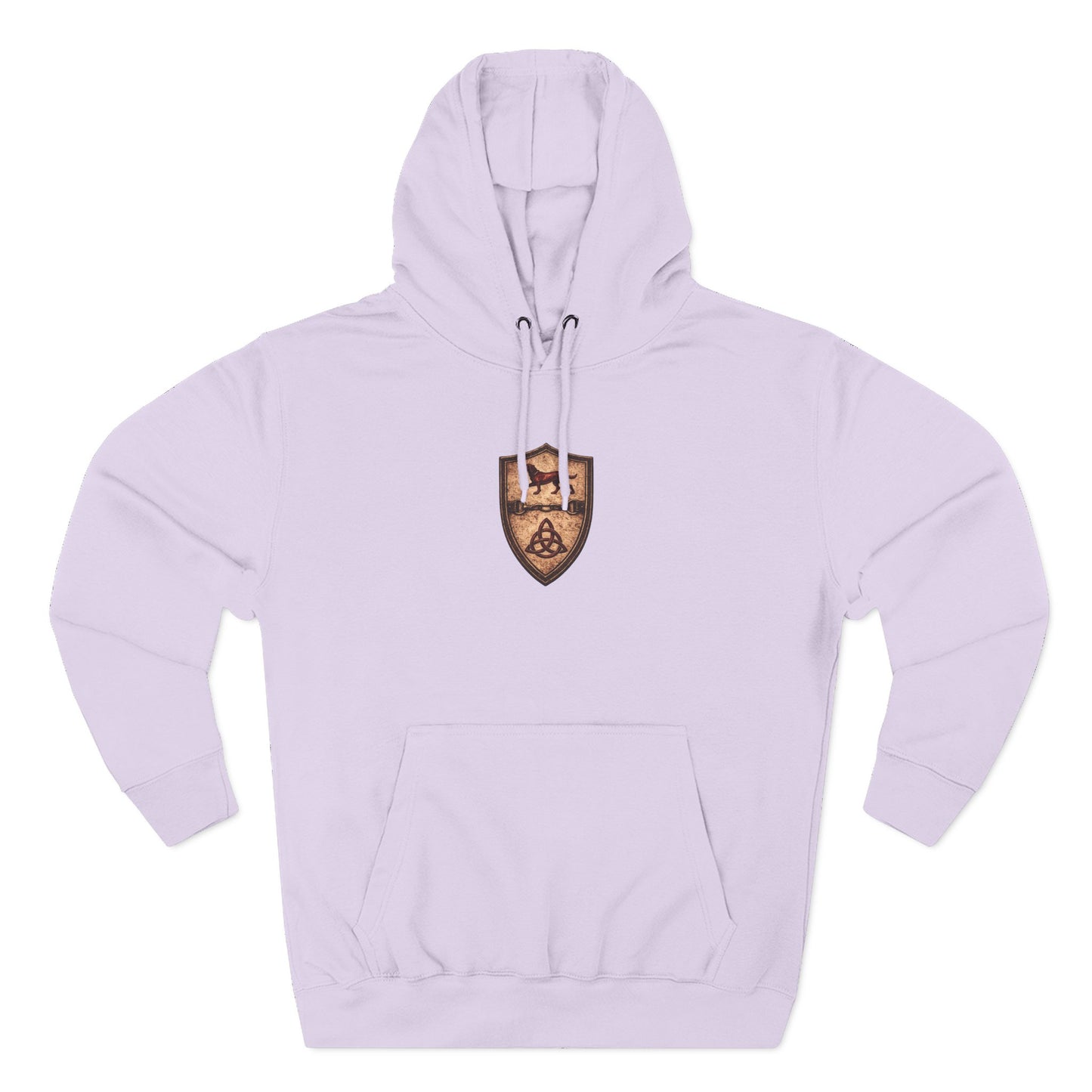
The phrase came together slowly. Fiducia entered Latin in the first century B.C. as a Roman legal term — a trust in property held by one party for the benefit of another. By the time Augustine of Hippo wrote in the early fifth century, the word had migrated from contract law to the disposition of the soul, meaning the trust a man places in God, in his lord — the mutual oath at the heart of the feudal system — and in the bonds he has sworn. Perseverantia took longer. Augustine rehabilitated it as a virtue in his last works, arguing it was a continuing grace rather than mere stubbornness. Temperantia was the oldest as a named virtue, descending from Plato and Aristotle through Cicero into the Christian moral vocabulary, where Aquinas placed it among the four cardinal pillars of a just life.
By the high medieval period the three words had been put to work on shields, walls, and the inside flaps of psalters. Bernard of Clairvaux, abbot of Clairvaux from 1115 to 1153, preached on perseverance for forty years and on trust for nearly as long. Thomas Aquinas, writing the Secunda Secundae of the Summa Theologiae between 1271 and 1272, argued that temperance was the virtue that kept the others from collapsing into their own excess. Without it, fortitude becomes recklessness, justice becomes cruelty, and prudence becomes mere cunning. More than a century later, Christine de Pizan put the same argument more plainly in her court treatises: temperance is the bridle on every other good. The metaphor would last another four hundred years.
Why the Three Together
- Hound passant at the head — fiducia, the faithful watcher, drawn from Isidore and the bestiaries.
- Bridle and bit at the fess point — temperantia, the governing hand, codified by Ripa in 1593.
- Triquetra at the base — perseverantia, the unbroken loop, descended from Insular and Norse craft.
- The motto banners — read bottom-left to bottom-right to top, the order of moral development.
- The cape and the rearing horse — context, the unbridled power that the shield's emblem governs.
