


The banner belongs to a long tradition of Latin mottoes worn on the body and the wall. The most famous of them, memento mori — remember that you must die — hung in Roman triumphs and medieval cloisters alike as a check on pride; its gentler companion amor fati, the love of one's fate, ran from the Stoics into the same stream. The Stoic emperor Marcus Aurelius returned to the theme throughout his Meditations, as Seneca and Epictetus had before him, and the tradition kept a companion phrase of its own — memento vivere, remember to live. Renaissance emblem books captioned interlaced knots nunquam frangitur — never broken. Other mottoes of the same family still travel: per aspera ad astra, through hardships to the stars; audentes fortuna iuvat, fortune favors the bold; dum spiro spero, while I breathe, I hope; and carpe diem, seize the day. Temperantia, Fiducia, Perseverantia stands in that company: not a warning and not a resignation, but a working instruction — three words for how to hold a line.
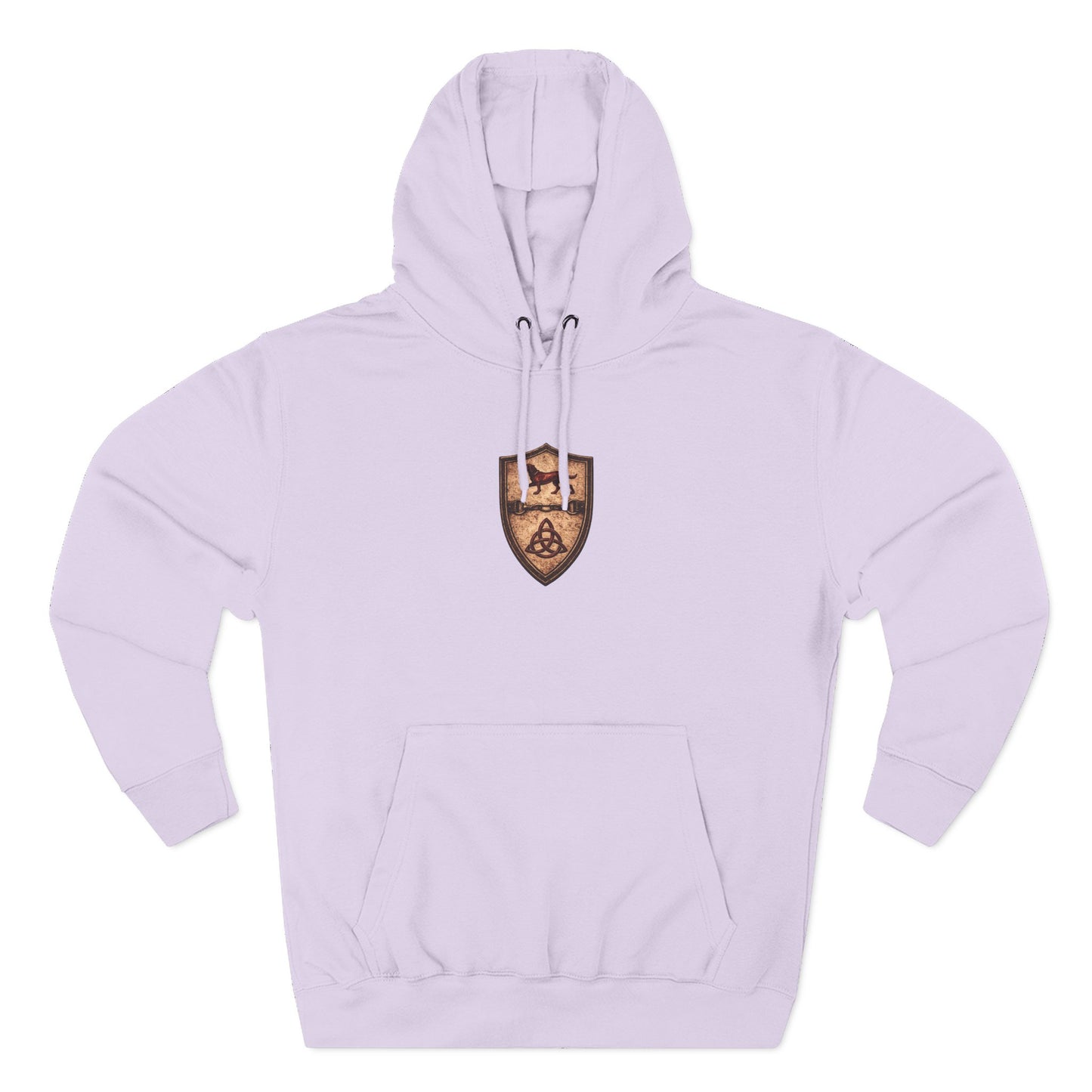
The triquetra at the foot of the shield is older than the other two emblems by several centuries. It appears in the marginalia of the Book of Kells around 800, in the carved stone crosses of Iona and Lindisfarne, and on the eleventh-century Funbo Runestones in Sweden. Originally a Celtic and Norse design motif from roughly 400 to 700, it was absorbed by Insular Christian art as a symbol of the Trinity — three persons, one substance, one unbroken loop. The geometry made the argument for perseverance: an endless line, three arcs returning to themselves with no beginning or end. Renaissance emblem books captioned interlaced devices of this kind nunquam frangitur, meaning never broken. When the heraldic tradition needed a symbol for the active form of constancy, the triquetra was already waiting, eight centuries old, ready for the work.
Why the Three Together
- Hound passant at the head — fiducia, the faithful watcher, drawn from Isidore and the bestiaries.
- Bridle and bit at the fess point — temperantia, the governing hand, codified by Ripa in 1593.
- Triquetra at the base — perseverantia, the unbroken loop, descended from Insular and Norse craft.
- The motto banners — read bottom-left to bottom-right to top, the order of moral development.
- The cape and the rearing horse — context, the unbridled power that the shield's emblem governs.
